

Changing an ostomy appliance doesn’t have to be complicated, but there are a few things you’ll want to do in order to do it right.
Table of Contents
Intro to Changing Your Ostomy Appliance
The following steps assume that you have an uncomplicated stoma and use a regular one or two-piece appliance.
This guide should be helpful to all ostomates (urostomates, ileostomates, colostomates), although some steps may need to be tweaked/omitted depending on the stoma type.
The most common optional steps have been listed, although there are many more special steps that some ostomates may need due to a complication or difficult stoma.
Disclaimer: As always, I suggest speaking to a stoma nurse if you are having problems with your stoma or ostomy appliance.
If you’re a new ostomate you may not know when to change your appliance. You’ll get better with experience, but I do have a guide to help HERE.
Video (recommended)

By playing the above video you agree to YouTube's Terms and Conditions and Privacy Policy
Supplies used in this video include:
- Perfect Choice Barrier Ring (BR1001)
- Hollister New Image Pouch (#18183)
- Hollister New Image Wafer (#14603)
- Niltac Adhesive Remover wipes (TR102)
- Niltac Adhesive Remover Spray (TR101)
Preparation
Preparation is an important step that helps to keep stress levels down and provides you with a clean and organized workspace.
This includes gathering any supplies you’ll be needing as well as making sure that you don’t have anything urgent to get to during the next hour or so.
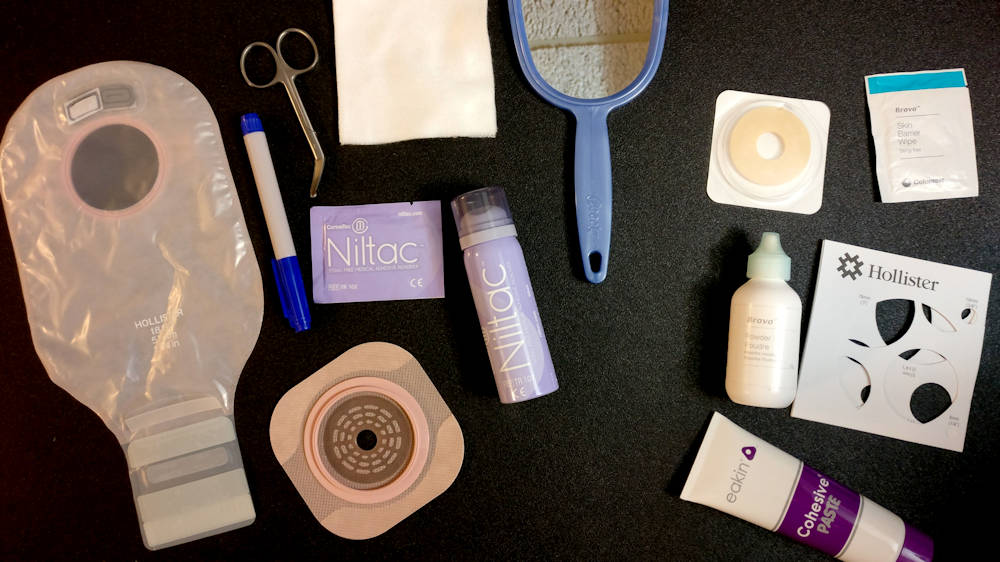
Here are supplies I tend to always have on hand when doing an appliance change:
- Stoma bag and wafer (or just a bag if it’s a one-piece appliance). Obviously, this will be required!
- Adhesive remover spray and/or wipes. Absolutely necessary if you find that your appliance or other supplies are difficult to remove from your skin.
- Ostomy scissors. These are only necessary if you are cutting your wafer, so there’s no need for them if you use a pre-cut or moldable wafer. I recommend this pair from Coloplast (Amazon.com affiliate link)
- Small bag to dispose of soiled supplies and to catch any output that comes out while I’ve got my appliance off. “Kitchen catcher” bags tend to be perfect for this.
- Mirror. This can either be a small, pocket mirror or one that sits on the bathroom sink. Make sure to use one that stands on its own, preferably one that can be adjusted.
- Gauze or paper towels. I use gauze to clean around my stoma, to make sure my stoma is dry before putting my appliance on. I prefer using gauze over toilet paper or paper towel because it doesn’t stick or break apart easily (my insurance covers gauze, so that helps).
- Pen or marker. If you are cutting your own wafer then this will be handy, although not absolutely necessary.
- (optional) Stoma measuring guide. Makes measuring your stoma easier if you use cut-to-fit wafers.
- (optional) Tampons(!). I’ve had more than a few people (with either a urostomy or ileostomy) tell me that they use tampons to absorb urine/output while cleaning around their stoma. This can be an alternative to using gauze.
- (optional) Barrier rings, barrier wipes, stoma paste, adhesive, protective sheets, etc. Not everyone needs these, but if your nurse has told you to use them, then you’ll want these easily accessible during your appliance change.
- (optional) Gelling products, pouch deodorants, wafer extenders.
Steps to Changing Your Appliance
- Get supplies ready. It’s important to get everything ready before you start because it’ll help things to go smoothly and it’ll keep the stress down. If you don’t have a lot of counter space in your bathroom, invest in a hanging toiletry bag to keep your supplies in for easy access.
- (Optional, but highly recommended). I hang a bag under my stoma to catch any output during my change. It also makes it easier to dispose of soiled supplies. You can use plain “kitchen catcher” bags, or you can even find similar bags that are scented to help mask any odors during your appliance change.

- Gently remove your old appliance. Be careful not to pull your wafer off too fast, or you may damage your skin. If you find that you often have a lot of adhesive residues left on your skin or the wafer doesn’t come off very easily, try using an adhesive remover.

- Clean and dry the area around your stoma. You can do this with just plain water, but avoid using soaps with moisturizer if you do use soap. If there’s any residue on your skin, use an adhesive remover wipe to gently get rid of it, then rinse with water and dry. It’s really important that your skin is dry before applying any other products, including your wafer.

- Shave if needed. Allowing hair to grow under your wafer can cause leaks, irritation, ingrown hairs, and can itch. Guys with hairy stomachs may need to do this with every appliance change, and some women may find that shaving any fine hairs makes removing the wafer easier. For a guide to shaving around your stoma, please check out THIS guide.

- Measure your stoma and cut a hole in the wafer. Since stomas can change their size and shape, this step is something to consider. You can skip this step if you use a moldable or pre-cut appliance. It’s important to make sure that you do this properly, and if you’re having trouble then I have a separate guide you can read HERE.
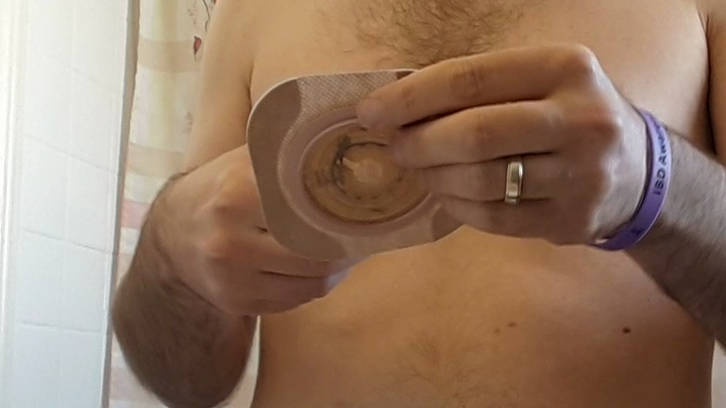
- (Optional) Apply barrier products, stoma powder, etc. If you use any other supplies, you can apply them to your skin now. As a side note, don’t use extra supplies just because you can – more often than not, less is better!
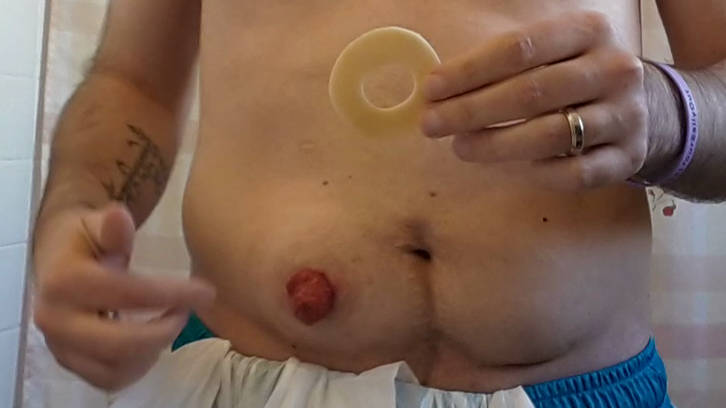
- Do a “Dry run” to make sure the appliance is cut right. To do this, place your wafer over your stoma without removing the back liner. Check to make sure that everything has been cut properly, and it fits around your stoma with enough of a gap. Adjust the hole that you’ve cut in your wafer if you need to.

- Remove the liner from the wafer and apply the new wafer to your skin. If you’ve got a two-piece, then attach your bag after applying your wafer. One suggestion that I would make during this step is to dry your stoma with some gauze so that it’s not really wet or leaking; any moisture that comes in contact with your wafer will cause it not to stick.
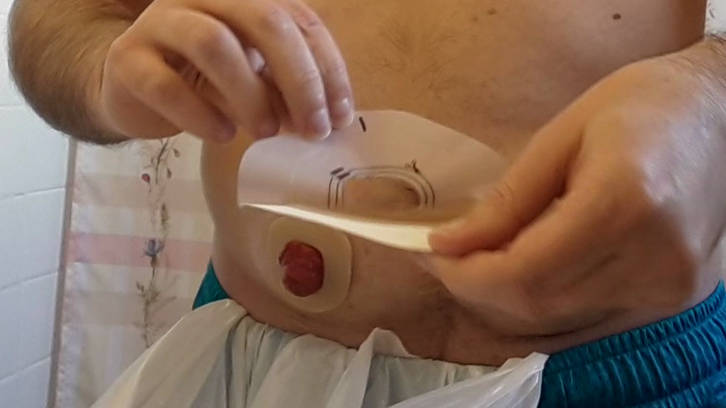
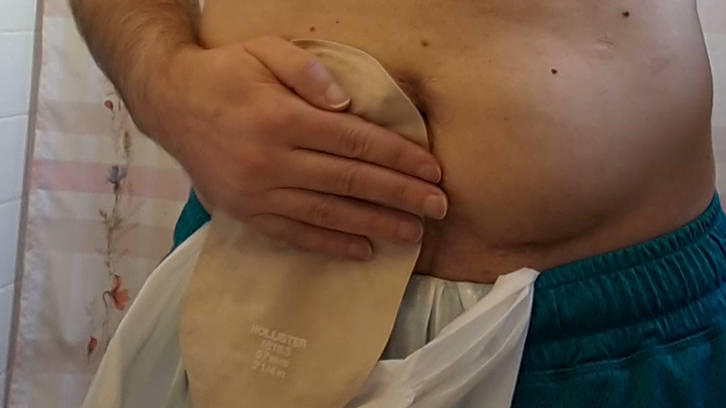
- Use your hand and apply gentle but firm pressure over your appliance for about a minute. The heat and pressure will help the adhesive to work better. I often find that having a hot shower AFTER putting on my appliance causes the adhesive to bond even better with my skin (resulting in longer wear times).
- (Optional) Add pouch deodorant and/or gelling products to the bag. If you’re using a one-piece or a two-piece with a closed-ended bag, you’re going to want to do this step before applying your wafer or bag.
- Clean up. And you are done!
This entire process can take five minutes or an hour. Go at your own pace – the goal is to wear an appliance that’s reliable, not set any land speed records!
Tips for Active stomas (ileostomy/colostomy)
One of the biggest challenges you might face when it comes time to change your appliance is an active stoma.
Having a stoma that’s constantly outputting will make pretty much all appliance changes more difficult.
Here are a few suggestions to help with that:
- Time your appliance changes. You may notice that your stoma is less active during certain parts of the day. Try to schedule your appliance changes during those times.
- Don’t eat/drink before an appliance change. Eating and drinking stimulate the peristalsis in your gut (it gets things moving!), so you’ll want to avoid eating/drinking a few hours before changing your appliance.
- Imodium. Some ostomates will use Imodium, or something similar, to slow down their bowels before an appliance change.
- Marshmallows. Many ostomates swear by this, but eating marshmallows can slow down your bowel movements. You can find vegan marshmallows on Amazon.com (Affiliate link).
- Laying down. I don’t recommend this, as it creates some other challenges during your appliance change, but some people might find that their stoma is less active when they are laying on their back.
Tip: If you’re having a problem with liquid output, then you may find THIS guide to be helpful.
Conclusion
I hope this guide has given you some direction on how to change an ostomy appliance.
Each person, stoma, and situation are different, so adjust these steps as you see fit.
I encourage you to also visit a stoma nurse so they can see how you’re changing your appliance and possibly offer ways to improve upon it.
Good luck!
Remember, if you’re having difficulty with your appliance, you should speak with an ET Nurse, who can guide you through specific techniques for your skin and body shape.
Question: Do you have any tips to share for pouch and wafer changes?



Hi there,
New to the ostomy world but glad I came across your website. I have an oval stoma and have issues getting it properly measured to cut the opening. I accidentally found a guide for oval stomas since no one bothered letting me know there was such a thing. Every sample comes with round template but no oval. And they are only available in paper. Why isn’t there a template made out of plastic that can be reused and easier to use? If there is please guide the way. I appreciate all of your advice and research and making me feel like I’m not alone.
Hey Trisha, glad you found the site!
Yeah, those paper templates are annoying. I guess they are cheaper to make, so that’s what we get.
The only plastic templates that I’ve ever come across came directly from manufacturers (I think they give these to nurses), and I was lucky to get my hands on them.
I’m not aware of any suppliers who sell them separately, but that doesn’t mean they aren’t available.
One thing you can do in the meantime, especially if the release liner on your wafer is plastic, is to trace the measured hole onto that, and then reuse it. I did that for years, and it works well.
You can even use any other plastic material that’s thin and flexible. Something like thicker sheet protectors/sleeves could work!
Good luck!
Trisha… Hi! Welcome to VO! I know it’s very frustrating having a stoma that’s hard to measure & cut a hole for. After about 8 years, I started with leaks all over again & very painful skin under the wafer & around the stoma.
On advice from others here, I remeasured my stoma & was upset to learn it was now a down facing capital letter D with kind of football ends to it. No straight lines.
On a lighter paper, less weight then the circle patterns in the box, I made a new circle & cut many wedges in it like a pie & then placed it over my stoma and one at a time, using a mirror & tweezers on some, I folded back each little wedge to fit around my stoma. Once dried, bcuz the stomas fluids had wet the paper, I taped down the bent wedges & then traced out a new pattern on better paper & gave the new pattern a try. I ALWAYS cycle the plastic from the wafers to be sure each new one fits & I test it against the new cut. My leaks became so much less I was overjoyed! Waking at night, is not an event I was wanting to repeat. The new pattern works well for me still, but over time there have been small changes & then I just make another pie to check the fit.
It seems to me Hollister had a plastic one available not too long ago. But, they have no way that I could see of keeping the paper one on my boxes of pouches & I couldn’t see it as being much use to me anyways,vbcuz,I just use the plastic from the wafer & I reuse that on a good fit. I use a black marker to date the plastic for good fit reasons as well.
You could use the plastic from a milk jug if that’ll work for you too. *One thing you should be aware of is that bcuz your stoma is NOT round, measure it frequently. Leaks can be a sign a change has been formed. If you loose even 5 pounds it can affect the fit of your wafer, so as it’s relatively new to you measure your fit with each change.
We all know how precious the skin beneath our wafer is. Its going to be vitally important to care for it as you would a newborn babies bottom!
Good luck going forward & I hope you enjoy the videos & information Eric has put together on so many important topics. Don’t be a stranger here. If you have any more questions please know that no question is a stupid question no matter how long you’ve had your stoma…
Hi Tricia – my stoma is an oval, also, and I use the Hollister plates that have a very thin plastic tear-off backing. I have been using an old backing as a template as long as I can, but they are flimsy and don’t last long.
Are you also using the barrier rings?
I change every three days; at that point the barrier ring has deteriorated to the point where I begin to worry about my skin. All in all I am ok with this.
And I know just what you mean about the vacuum effect! Mine does that sometimes for no reason at all that I can figure out – how in the world does this happen? When I see it I open at the top or bottom to get a little air in (I use a two-piece drainable set). And it is a mystery!
@llholiday … I used to use the barrier rings from the start of my ostomy. Then after reading here, I decided one day to try it without & I found I had wear times of 5 to 6 days. It was awesome for me. I’ve never used them since. I have a dip beside my belly button, about 4 inches long, which was never put back in place after my last surgery, which is under the wafer so I just spend extra time pressing on that area to try & get good/ better adhesion of the wafer to my skin. Heating the wafer with the blow dryer works very well for me.
Oh, the vacuume affect is what I call…. “reverse farting!" Lolol…
@dlkfiretruck I too have a dip now on the underside of my stoma . This is something new for me after my surgery as well as a kind of new buldge that kind of acts like a visor or an awning and I literally have to lift up that awning bulge to put my new appliance on. Also after getting it on , I’m noticing the ring melting around and even onto the stoma. If I put the hole in the bag up to my stoma there is too much room of skin exposed I’m.wondering if my stoma has shrunk again since my last stoma nurse appt. I’m wanting to try without a ring but I see all that exposed skin around it.
For now I set up an appt with the stoma nurse to address some things there bags just are not holding up as usual.
Hey Garrett ,I had both my ops using laparoscopic surgery ,and my surgeon for my second surgery remarked afterwards that there was very little scarring from my colectomy and made my protectomy a lot easier , best of luck with your surgery
Hi Eric,
Was your ileostomy done as open surgery or laparoscopically? I have recently learned of risks that are unique to laparoscopic surgery as opposed to open surgery.
Thank you
Hi Garrett,
Mine was laparoscopic, and I’m glad my surgeon went that route. It greatly minimizes scars.
There are risks to both types, but is there anything in particular that you’re worried about with laparoscopic surgery?
I use a water-based baby wipe to gently clean around the stoma, then an adhesive remover wipe over the wafer area followed by a warm wet Chux-style cloth to clean off the adhesive remover. Next step a barrier wipe and so on.