

When I had tested the one-piece SenSura Mio appliance, I was a bit disappointed but found enough strong points to recommend it to most ostomates. The two-piece system has been something that I’ve been looking forward to trying, and here’s my review!
Disclosure: This review is based on samples I received through the Coloplast customer service dept, as well as samples received during a patient feedback program. No other compensation was provided, and both my experience and opinions are completely my own.
Table of Contents
Video Review
By playing the above video you agree to YouTube's Terms and Conditions and Privacy Policy
About the Sensura Mio Click
Products I’ve used for this review
Product name: SenSura Mio Click baseplate
Manufacturer: Coloplast
Product #: 10502
Dimensions: 10-35mm, Cut-to-fit, flat wafer with 40mm coupling
Quantity per box: 5
Product name: SenSura Mio Click Narrow Outlet Drainable pouch w/ filter; opaque.
Manufacturer: Coloplast
Product #: 11432
Dimensions: 40mm flange coupling
Quantity per box: 10
Product name: SenSura Mio Click baseplate
Manufacturer: Coloplast
Product #: 10512
Dimensions: 10-45mm, Cut-to-fit, flat wafer with 50mm coupling
Quantity per box: 5
Product name: SenSura Mio Click Wide Outlet Drainable pouch w/ filter; opaque.
Manufacturer: Coloplast
Product #: 11472
Dimensions: 50mm flange coupling
Quantity per box: 10
The Sensura Mio Click is an inspired ostomy product line by Coloplast. It holds an impressive feature set and style that sets the bar for what an ostomy appliance should strive to be.
The SenSura Mio Click line comes with a staggering number of options, from opaque to transparent, filtered to filterless, wide outlet to narrow outlet, closed-ended to drainable, flat wafers and convex – you get the idea right? It’s a complete line that caters to any ostomate, including urostomates.
Coloplast is good when it comes to providing a complete package for ostomates, and the wafers are packaged with a reusable stoma measuring guide; the pouches come with small garbage bags and filter stickers.

The Wafer
The SenSura Mio Click wafers I’ve used are cut-to-fit, which means I have to measure my stoma and cut an opening to fit through the wafer.
These wafers are really easy to cut, and they have measuring guides that you can use if you know your stoma’s size before hand.

They do come with a single release liner, but the wafers are not individually sealed, which I find more difficult to carry in my travel bag.
For those looking for added security, the wafer does have four belt hook loops (vs. two you’d find on most other appliances), but it requires a special four-hooked accessory belt to take advantage of.

One of the benefits to the Sensura Mio Click is that the wafer is highly flexible and will work well with many body shapes.
Patients with hernias, for example, may find that the Mio will form-fit along curves better than some of the more rigid plastic wafers.
The thing that I like most about the Sensura Mio wafers, is the fact that my skin does really well with them!
I don’t find any irritation under the wafer or around the edges of the wafer (which were a problem on the Xpro and Assura line), and the skin around my stoma remains intact and healthy.
My results are great even without the use of barrier rings, barrier wipes, stoma powder, or anything else to help my skin. Kudos to Coloplast!
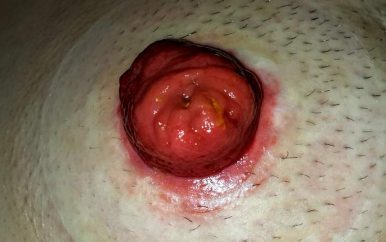
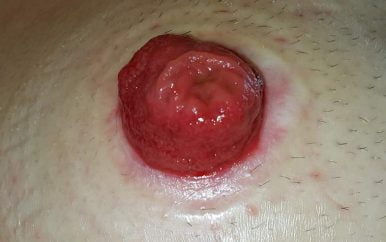
My wear time has been a consistent three days with zero to minimal wafer erosion.
This is actually much better than I had expected, and it did perform better than the one-piece; I experienced NO LEAKS while using these wafers.
Unfortunately, wafers in the Sensura Mio line are manufactured using gelatin, so these would personally not be a product I’d choose first, since I have alternatives that are free of animal-based ingredients.
One can only hope that Coloplast will replace gelatin in the future.
Info: The SenSura Mio is also available in convex, although it’s not a style that I’ve tried before.
The Pouch
I’ll be honest, the SenSura Mio bags are the best looking ostomy bags on the market right now, and they are the only one I’d confidently wear without a pouch cover.
The fabric cloth that’s used on the product is unlike anything you traditionally find on an ostomy bag.
The color is a neutral gray, and it does a great job of repelling water; I often find that after showers it takes very little effort to dry my pouch, and it would often be dry before I even finished using the bathroom.

Unlike many other brands that use opaque cloth bags, the fabric used on the Mio is durable and modern looking, and it’s nice and smooth.
As a bonus (which really should be a necessity on any opaque pouch), the fabric conceals the contents of my bag quite nicely.
The Mio Click, like many other Coloplast products, comes with a mechanical coupling that uses a locking mechanism to secure the bag. The style of the lock is slightly different from the SenSura Click, and it’s been improved to allow for easier access in a more reliable design.
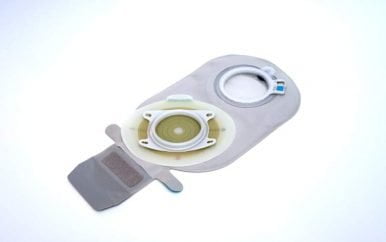
The lock does add a bit more bulk to the appliance, but when unlocked, it allows you to easily rotate your bag horizontally or diagonally before locking it back into place.
This is something that you’d have trouble doing on other appliances since freely rotating the bag isn’t as easy as it is with the Mio, and it’s often less reliable.

By playing the above video you agree to YouTube's Terms and Conditions and Privacy Policy
While the mechanical coupling on the Mio is great for convenience I found that it was useless if I needed to burp my appliance to release gas from the coupling. Attempting to burp my appliance basically causes the bag to completely come off!
I was over a toilet the first time I tried that, but I can’t imagine what kind of trouble I’d be in had I attempted that in bed on in my car! If you must burp this appliance, do it from the outlet while laying flat on your back.
Coloplast offers both a wide and narrow outlet to the SenSura Mio Click, with the narrow outlet designed specifically for ileostomates (I’ll refer to this as the “ileostomy bag” throughout the rest of the review).
The narrow outlet pouch differs from the wide outlet version in a few ways, which I’ve detailed in THIS post.
Basically, you have no velcro tabs from which to hold the outlet flap open while you empty your pouch, and you also have a different filter design, which I’ll explain more of in the next section.

While I do prefer the wide outlet, the exclusion of the Velcro tabs on the narrow outlet bags really made it difficult for me to empty my pouch, or clean it without getting my hands dirty (quite literally!).
I’m sure ileostomates with liquid output might find it easier to empty with this design, but I found it quite a challenge that easily added another 20 seconds to my routine as I struggled to clean the opening and the flap.
You will still find Velcro fasteners at the end of the outlet, which keeps the outlet securely closed, and you can tuck that outlet neatly on the bottom, or fold it in half for a more compact look.
Like the one-piece, I really appreciate the attention to detail on these bags, and you can easily find the model number and lot number on the top of the pouch, under the fabric flap.
A nice touch that Coloplast added to the Sensor Mio bag is the inspection window which allows you to see what’s happening inside your pouch without having to resort to wearing a clear pouch.

The Filter
As I mentioned previously, the wide and narrow outlet bags both feature different filters, or more accurately: pre-filters.
If you look closely at the two styles, you’ll notice the wide outlet pre-filter has many small holes in it; this can help to remove gas from your pouch, provided your output is dry enough not to clog it up!
The narrow outlet bags have pre-filters with only a few holes, and that should help to keep ileostomy output from clogging it.
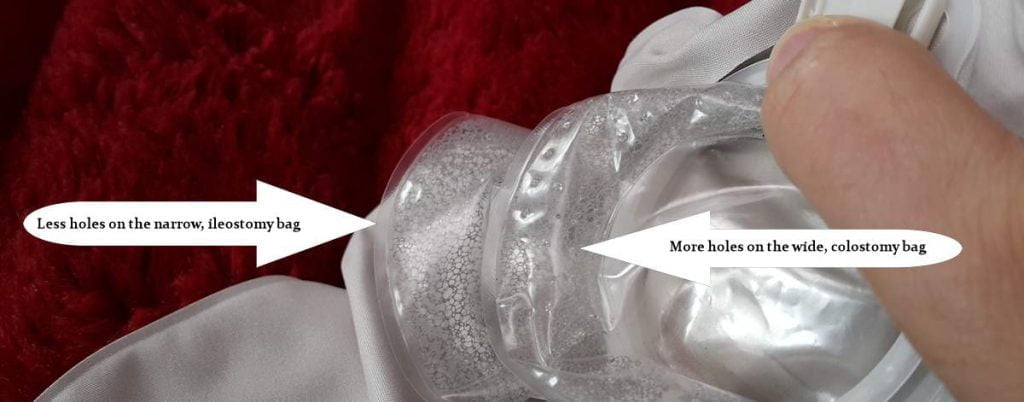
But does it work??
I do find that the ileostomy bags work better than the colostomy bags (wide outlet bags) when it came to minimizing ballooning, however the results are still inconsistent; I found that on certain days I would have pouch balloon within 24 hours, while at other times I could go a full 3 days without ever having any pouch ballooning.
Tip: If ballooning is an issue with these bags, considering using the Osto EZ-Vent. I’ve got special instructions on how to get it working with this bag HERE. I’ve also got an entire article on ways to prevent ballooning HERE.
Since my output tends to be thick (for an ileostomate) this is a little concerning as I know that liquid output will probably clog this filter up much faster than the output that I’ve got.
I’m also not a fan of the large pre-filter that either of these pouches come with. One of the reasons for this is because I find that no matter how empty my pouch is, it always feels like it still has something in it.
This happens because over time the pre-filter will collect fluid without giving it any place to go so it’s basically like you’re carrying a sponge in your bag.

For some, the feeling this causes may be annoying, considering you have to wear an appliance 24 hours a day, and I do find it frustrating to have to double-check and triple-check to make sure that my bag really is empty.
I would have preferred no pre-filter and simply a small filter like what you’ll find on Hollister, ConvaTec, B. Braun and other ostomy bags. While there is an option to go with a filterless bag, this defeats the purpose for anyone who has ballooning issues.
There is one advantage to having a pre-filter, though, and it’s the fact that I’ve never noticed the pouch sagging when it got full.
But the large pre-filter is also a problem if you’re the type of person who wears stoma guards. Some stoma guards simply don’t have enough room for everything to fit under them comfortably with pre-filter there – it’s overcrowding, to say the least!
Some ostomates may also find that the large pre-filter creates pancaking issues or makes pancaking worse for people who already struggle with that problem. I noticed this happening a lot, where I wouldn’t normally notice it on other appliances.
One thing I do need to point out is that the outer filter is not waterproof, so you do need to use the included filter stickers if you plan on having a shower or going for a swim with this appliance; not covering the filter can lead to water clogging it from the outside.
Conclusion
At the time of this writing (Dec 2015), the SenSura Mio Click is available worldwide. I find that the prices on these are about average, but still more than a one-piece.
Coloplast is great for sending samples, and you can request them from your local Coloplast office.
Pros:
- Comfortable.
- Gentle on the skin.
- Flexible wafers.
- Locking mechanical coupling is very secure.
- The pouch fabric is in a class of its own, both in quality and aesthetics.
- The inspection window is a really nice touch.
- The velcro closure locks are convenient and secure.
- The fabric cover is the most water-resistant I’ve seen on any appliance.
- Available pretty much everywhere.
- The filter on the ileostomy bag does work fairly well.
- The wafer is easy to cut and contains a measuring guide on the release liner.
- Wafer holds out great during showers.
- Wafer held up very nicely, even after 3 days.
Cons:
- I found the lack of velcro tabs on the ileostomy bag to be challenging.
- Contains animal ingredients.
- The large pre-filter can feel quite bulky.
- The pre-filter often exaggerates pancaking.
- The pre-filter makes it hard to wear a stoma guard.
- Can’t burp the bag from the coupling.
- The outlet flap on the narrow outlet often makes it difficult to clean.
Recommended
The Coloplast SenSura Mio Click is a well-rounded appliance, and you can tell that a lot of work went into the design of this product; it’s worth checking out if you didn’t have much success with the one-piece Mio.
For those who have been disappointed with the filter performance on the wide outlet bags, you will have the option to use the ileostomy bags for better results.
While the system does have a few flaws, mostly coming from the size of the pre-filter, may ostomates may overlook them in favor of the next-level fabric and design.
Info: For more information, please visit the Coloplast website at www.coloplast.com
Bonus: A Review on the Convex Urostomy Mio Click System
The following review was shared to me by a urostomate, Stephen, who’s been able to write about his experience with the Convex Urostomy version of this system. This is information that I could never provide first-hand, so I am grateful for his effort in putting this together.
Bag pt no. (11498), backing plate pt no. (16911)
I recently trialed a couple of new products from the new SenSura Mio convex range of urostomy bags, the result of suggestions made during a meeting with my stoma nurse about my slightly recessed stoma. Up to this point, due to issues with non convex Hydro Colloid bags, I had been using microskin bags.
The most recent bag I trialed was the SenSura Mio 2-piece “click” convex urostomy bag. I received as samples two convex light baseplates and four clear “click” bags (I much prefer clear bags, as it’s much easier to check on what’s happening with my stoma).
Due to the built in plastic cup the baseplate really is quite bulky, protruding somewhat and making it visible under tighter fitting trousers. However, I found the “soft seal” element of the baseplate made it relatively flexible, and I experienced no discomfort. Adhesion was excellent and remained so even after a bath (bathwater also just ran off the fabric backing of the bag).
I did find that enlarging the hole to accommodate my stoma required accuracy, there is little room for error, so I left this to my wife! (in the long term it may make sense to use Charter’s pre-cutting service). Placing the baseplate was quick and easy, with very few wrinkles in the adhesive backing requiring smoothing out.
After reading the instructions fitting the bag to the baseplate proved easy and the locking ring easy to operate. Ease of operation of the locking ring was a feature I particularly liked, easy to secure the bag preventing it from slipping and easy to unlock and rotate the bag to any angle I wanted, for example to 45O when I connected the bag to a leg bag before I went hiking. Removing the bag to clean/flush it out, clean the plastic cup of the baseplate and my stoma proved relatively quick and easy, which is something you can’t do with a 1-piece bag, (just remember to tuck a plastic bag into your waistband to catch output while you do this)
Degradation of the hydro colloid part of the baseplate at 96 hours before replacement was much better that I had experienced with non-convex hydro colloid bags, where the wear time had been as low as 10 hours! I used two bags per baseplate, replacing the first bag after approximately 48 hours.
After trialing the new SenSura Mio 2-piece “click” convex bags, I am happy enough with them to have requested a batch on my most recent prescription order for use as my main bag. I will however still be keeping a small supply of microskin bags as well.
Stephen



I received the sample of this 2-piece system from Coloplast, and am kind of shocked at the amount of negatives it has.
Since it’s known that all filters seem to clog up pretty fast no matter the brand, having no way to burp the bag once the filter is clogged (without adding another product like the EZ burp product) is a deal breaker.
Having the pre-filter clog up as well isn’t good.
As it’s been pointed out, without a “floating flange" to be able to press the bag onto, and having to press against your body hard enough to get it to click just doesn’t seem safe at all. Yes, you could attach the bag before applying the flange to your body during a change, but what if you need to remove the bag for some reason after that.
Trying to rotate the bag with the lock clicked off, was very tight and felt like I would rotate/pull the flange off of me, it was so tight. The lock too, seemed very difficult to unlock. Maybe I’m doing something wrong, but was difficult for me.
The bottom velcro closure seems like the only good thing.
@Tim Thanks for sharing your experience, Tim!
What appliance did you come from before trying the 2pc Mio?
Ditto Tim. Two wks w/ Sensura Mio. The barrier is one of the best. Unlike Hollister, it doesn’t deteriorate w/wear & shower. Nice heavy pouch w/cover that is durable. I just opened the flap & raised the drain-Burp! Yes, tiny lock is awkward to manage. The elderly/arthritic will hate that.
Negatives: The filter is a loss. Pancakes like crazy(tried lubing the top). Hard to “strafe" excess poop down from top. Attaching to barrier was Impossible. No floating flange & cannot get enough pressure under to “Click". Ended up using it like a one piece & attaching beforehand. Got a little peristomal skin irritation, as not a perfect fit. The Coup de Gras. Emptying is a MESS! Wide floppy ends smear poop everywhere! Both hands, pouch, velcro & toilet seat, YUCK!
Going back to Hollister. Lighter & easy to empty. I pre cut their tiny flaps equally & very little lingering poop on the ends.
As far as the attaching the bag to the wafer, I have found if you line it up at the bottom and slide your hands up both sides applying some pressure, when you get to the top, it clicks in place pretty easily.
Firstly, Eric, thank you for your informative, helpful, “no nonsense" site.
Since my APR surgery on 10 February I have been using the Hollister New Image 2-piece system, with its CeraPlus Skin Barrier and a drainable pouch. The skin barrier is excellent: flexible, secure, and I get 5 days wear with no skin irritation. The Hollister “floating flange" makes it easy to get your thumbs behind the flange to press on the pouch and secure it in a pinching motion between finger and thumb. The pouch itself is not so good, however: the non-woven fabric cover roughs up after a couple of days, can get damp in the shower, and the end of the tail is quite hard to clean because of the thin, 1mm or so, floppy plastic that extends past the thicker end of the tail. It does always feel secure when rolled up, though, and the filter works very well.
I tried a sample Sensura Mio click wafer and drainable pouch for the first time at my last appliance change.
The pouch is really excellent: good quality material, good shape, easy to empty and clean the tail, shrugs off water, the tail tucks away, and the pouch can be folded if required. Very good all round.
I’m not so sure about the wafer though: unlike Hollister’s “floating flange", I found it very difficult to press hard enough on the wafer when it was on my abdomen to get it to click. It took about five minutes and was quite frustrating. And, it’s only been on two days and the outer edges already seem to be peeling away from my skin, which is making me feel slightly nervous. (My skin was clean and dry, with no use of moisturizers or anything like that before I fitted the wafer.). I did also try lubricating the flange with a drop of hair clipper oil to make it easy to rotate the pouch (per the posting on this site) but it was still too stiff.
If there was a manufacturer that could combine the best aspects of the Coloplast Sensura Mio pouch with the Hollister New Image wafer, they’d clean up!
Thanks for sharing that, Alastair! Wouldn’t it be great if an “open-source" ostomy kit was available to mix and match various brands? There are some adhesive coupling 2pc systems that are compatible with each other, but the adhesive coupling (in my opinion) causes more trouble than it’s supposed to solve.
@Alastair
I agree. I have been using the Sensura Mio click. They start to peel away from my skin too, so I have been using wafer extenders and that helps quite a bit. They do start to pull away too, but I have really dry skin. They do give me some extra time though. You might give then a try. I’ve used both coloplast and Hollister. I prefer the Hollister ones.
Absolutely. There’s always a give and take when it comes to what the goal is with these formulations. It’s possible to have a product that’s extremely gentle on everyone’s skin, but maybe it only has a 24h wear time. Likewise, you can probably design a wafer intended to wear for weeks, but good luck getting that to work with everyone.
I’m sure that the softer, more flexible Mio wafers (which I also find to be very skin-friendly) have reduced wear times vs. other products. Perhaps in time, their formula will improve to offer longer wear times for more people.
interesting JTV. if you roll over on your stomach at night will the stoma bleed? mine only seems to bleed when I’m cleaning around it with a paper towel. of course it could bleed at other times and I do not know it. is your stoma sensitive to touch? my colostomy isn’t, i can bang on it all day without trouble, grandulomas don’t like being touched though.
BOB, how many failures do you find per box of 10 near the 10th month per expiration date?
I recently wore a 8-10yr old convetec and couple weeks later a brand new sample, the wear times were basically the same from old to new I really question these so-called expiration dated bags. really like to see some hard data, not just a manufacturer suggestions.
the Mio was initially a closed end bag designed to be removed daily. the first drainables, about 8 yrs ago or so came out, I tried them and they lasted 3-4days, recently I tried a Mio again and the wear time was about the same as if they are still basically a drainable closed end style flange.
lots of variables i find with leaks,:
how clean was the skin,
how hot did I get the flange
how long I kept pressure on the bag putting it on.
how much bending I do, not a constant for sure.
pinning it down to its manufacture date would require a whole lot of testing. at least 3 – 4 boxes.
@dogtalkerer
I’m not sure about rolling over on it as I haven’t slept on my stomach, even inadvertently, since I was stomatized. I actually miss it. The stoma is very friable and bleeds with cleaning, after a long day under a guard, or even with a waist band that rides up or down without a guard on. I grazed it with a ski pole causing a small laceration and it bled A LOT. It also healed quickly. It’s highly vascularized tissue so all of this is probably normal. No somatic sensory receptors in intestine so no, there is little pain associated with the damage. I do have pain around the stoma and some visceral discomfort but thats a different story. I can’t speak to using product near the expiration date as I’ve only had this thing for 4 months. I would feel perfectly comfortable using pouches indefinitely. The wafers make me more nervous but I’ll probably use them beyond their best by date. I did have some freeze on me then thaw with a lot of condensation so I’m saving those for a rainy day.
Bruising your stoma is BAD! I use a Stoma Guard by Stealth Belt. Fits into their belt. Sounds like you have some peristomal leakage. Try crusting.
A little blood while cleaning is normal. Got into a Hollister Trial. They sent me the same products as always, but they were old. I noticed they deteriorated a bit quicker than usual. Got $100 for trying.
To weigh in on the debate, not that anyone asked me… I agree with those who have highlighted individual differences as dictating which system is best. It was said above that the 2 piece is not an active person’s friend but it is if you have a higher output ileostomy with a long stoma. The flange on the 2 piece serves as an essential part of my stomal protection. My spout is long enough that all the stoma guards I’ve tried tend to crush my stoma and prevent output. The flange lifts the guard off my stoma which is key. I agree that the 2 piece is more rigid and kind of a pain in the ass with deep bending but it’s better than a bleeding stoma surrounded by an exploding pancake!