

Ostomates have a lot of options to choose from when it comes to pouching systems, but it’s not always clear what the advantages and disadvantages are between a one-piece or a two-piece system. I hope that you’ll be able to learn the differences in the following post.
Table of Contents
Video

By playing the above video you agree to YouTube's Terms and Conditions and Privacy Policy
One-Piece Ostomy Systems

This is probably the ostomy system you’ll leave the hospital with. A one-piece means that the wafer (the part that sticks to your skin) is fused to your pouch right of the box. You can’t separate the pouch from the wafer.
Advantages of a one-piece appliance
- Lower profile vs most two-piece systems.
- Usually costs less than two-piece systems.
- Fewer supplies to manage.
- Some people find them more comfortable, especially if they have a less-than-perfect tummy or a hernia.
- Zero chance of your bag falling off (but the wafer still can!).
- Takes up less storage space, especially in a travel bag.
- Less time to make an appliance change.
With a one-piece, the goal is simplicity. Some people love the minimal aspect of a one-piece, but there are some disadvantages too, assuming they are things that you find lacking.
Disadvantages of a one-piece appliance
- Higher chance of getting an imperfect fit.
- No option to rotate your pouch at will (an advantage if you use a Stealth Belt).
- Can be more difficult to apply.
- If you have to change the wafer early, you end up having to throw away the pouch, too.
- If you have a problem with the pouch portion, you have to change the wafer, too.
- No option to change to a different size/style pouch to accommodate different activities.
- Can’t use pouch liners.
- Can’t easily “burp” your pouch to get rid of excess gas.
- Changing closed, one-piece pouches often can lead to skin irritation.
So while you have simplicity, you also lack some flexibility in options. In my experience, one-piece appliances are comfortable, but I always feel that I’m not getting a perfect fit around my stoma in the same way that I can with a two-piece, especially with seeing and/or correcting a gap that might be between my stoma and the cut-out in the wafer.
Two-Piece Ostomy Systems
With a two-piece, you have a separate wafer and pouch. You have an option of sticking the wafer to your skin before applying a pouch, which means that you can have a better look at your stoma and that usually results in achieving a better fit. There are several types of two-piece systems, and each manufacturer has their own coupling method. Here are the most common types:
Adhesive coupling

Like a hybrid of the two different ostomy systems, an adhesive coupling offers you some advantages of having a two-piece, but with the low profile and the added comfort of a one piece. This is done by replacing a hard plastic coupling with an adhesive coupling, which you stick onto a designated spot on your wafer. While some manufacturers say that you can remove the pouch and reapply/adjust it, many ostomates find that doing that is just asking for a leak.
Leaks are a big disadvantage with adhesive coupling systems. If you don’t stick the pouch perfectly onto the wafer, you’ll get a leak between your pouch and wafer. For that reason, I don’t suggest this type of coupling system to anyone who has dexterity, mobility or vision problems.
Some ostomates will stick the pouch to the wafer before applying the wafer to their skin. This effectively means that you are using it as a one-piece.
Mechanical coupling (with lock)

This is an option that Coloplast has perfected, and it’s a huge part of the Click line of products they offer.
This system allows you to mechanically snap your pouch to your wafer and then lock it in place.
The beauty of this coupling is that it allows you to lock and unlock your pouch whenever you like, which is handy for rotating your pouch at will (like when using a Stealth Belt).
I feel completely secure when using a locking coupling, and if you have a high-output stoma which has resulted in your pouch falling off in the past, then this is a system you might want to try.
If you have dexterity or mobility problems in your hands, especially joint pains, then you might find the locking mechanism to be difficult to use.
I’ve read stories on forums where this has been an issue.
Another advantage that I’ve noticed when using 2pc systems with mechanical couplings is that it offers some basic level of protection against impact since the coupling is raised a bit.
If your stoma is flush or slightly protruded, then this might be a good alternative to stoma guards (again, for very basic protection).
Mechanical coupling (snap-in)
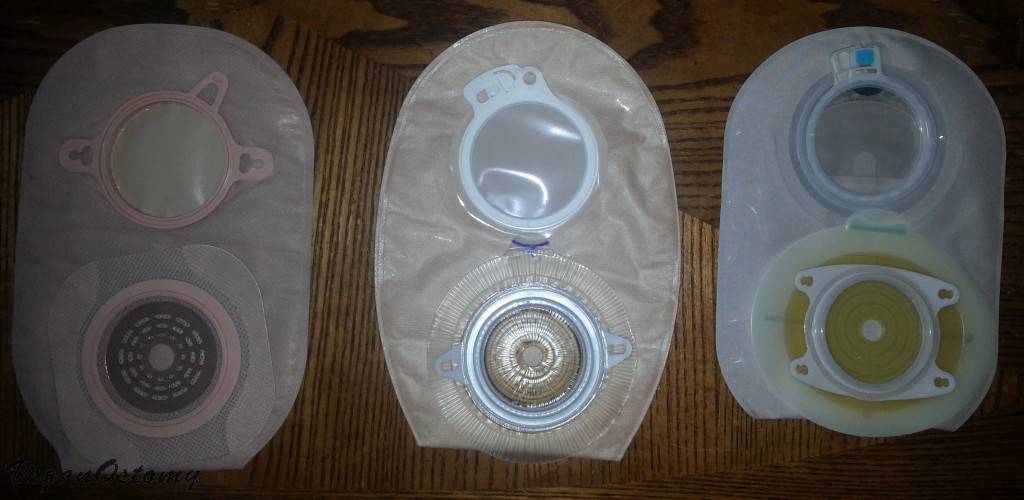
This type of two-piece has a simple system that allows your pouch to snap into place on the wafer. This is common on Hollister products and works well. There is a small chance of your pouch falling off or leaking if it’s full and you’re doing a lot of running or jumping, but using a support belt or ostomy wrap will add an additional level of security to help prevent those issues.
One thing that I’ve found with snap-in couplings is that you can’t easily rotate them. You have to take your pouch off, rotate, then snap it back into place. While that sounds easy enough, I find that it only creates an opportunity for leaks.
Tip: I’ve found an easy way to help rotate these stubborn 2pc systems. Check it out HERE.
As I mentioned in the section above, this style of mechanical coupling may also give a basic level of stoma protection.
Advantages of a two-piece appliance
- Allows for rotation of the pouch (some two-pieces).
- Some mechanical coupling 2pc systems are easy to “burp” when gas builds up.
- Can make it easier to get a perfect fit around your stoma (allows visual confirmation that the wafer was cut properly).
- Allows you to replace your pouch without having to change your wafer.
- In the case of an ileoscopy (scoped through the stoma), you likely won’t need to remove your wafer and can simply remove your pouch.
- Allows you to swap between different pouches (that are compatible with your wafer); great if you use a high-capacity pouch at night and a smaller one during the day.
- Can be used with disposable pouch liners.
- Two-piece systems with mechanical couplings may offer some level of protection against stoma impact.
- If you’re a colostomate, and you irrigate your colon, using a two-piece system allows you to easily remove your primary bag and swap it with an irrigation sleeve, then replace it when you’re done – all without having to remove your wafer.
Disadvantages of a two-piece appliance
- Mechanical couplings add stiffness and bulk to the pouch; locking couplings are even more obtrusive
- more expensive to purchase a separate wafer and pouch vs. a one-piece
- some bags can detach or leak from the coupling
- mechanical couplings are not ideal for hernias
Closing Thoughts
So which option is better for you? That’s probably something you’ll need to investigate yourself by sampling products from various manufacturers.
You may even decide to switch between systems, depending on your plans for that week or month.
Question: Are you a fan of one-piece or two-piece ostomy systems? Why/why not?


Hi Bill, I mean the waxy ring under the flange/plate (so I was meaning preventing links at the top, actually). . I think most people use them, but I have heard of some that don’t seem to need them. LL
I too have never had a failure of the lock and roll fastener in over 3 years. On occasion I have rolled up the end a couple of times and put a rubber band around it. This is to keep the plastic parts from scratching my leg while exercising.LL what kind of ring are you talking about? I use a Nu Hope support belt that has a ring. Maybe that is what you are referring to.
Hi Brenda, I use the Hollister with the Velcro lock-and-roll, and the Velcro has never failed (my ostomy is 15 months old). Once in awhile, if I want a little more security I use one of those little metal clamp/clips (like the ones Nuffy mentioned) which I can get from Office Supply. I also use a ring under the flange – the ring is a wonderful invention; without the ring I think I would get a leak. Best to you LL
I use Hollister 2 piece system and I haven’t had any issues
Glad to hear that, Kianda! Hollister has been my goto appliance for quite a while now.
Hi Brenda,I am late coming on to this, but I was wondering if you have checked with your stoma nurse as to what body type you are. Your body type may be enabling the leaks and you may not be using the best system for you. I found out that I have imperfections in the area around my stoma and discovered that I needed a convex system. I use the Sensura Mio Convex, and so far, no leaks. I also use a paste in the areas around the stoma that are indented and that helps the skin to stick more to the barrier. I hope this gives you something more to consider. Good luck!Stella