

Blockages and partial blockages are a concern for ostomates, especially ileostomates, but there are several ways to both prevent and treat minor blockages.
In this article, I’ll go over some tips that I’ve found to be helpful in my own experience, but these tips shouldn’t replace the advice of your care provider.
Caution: Blockages are no joke, and I’ve been sent to the hospital because of one. If you feel that you might have anything more than a partial blockage, you should visit your local ER just in case.
Table of Contents
Video

By playing the above video you agree to YouTube's Terms and Conditions and Privacy Policy
Causes of Blockages (Also Called a Bowel Obstruction)
Blockages can be caused by a number of reasons, but not all causes are in our control.
Some ostomates, for example, have strictures or motility issues that increase the chance of blockages. These people should work with their doctor to find solutions that help prevent blockages, including surgery.
Pregnancy, especially in the second and third trimesters, is a risk factor for bowel obstructions as well. If you are pregnant, it’s best to work with both a stoma nurse and an obstetrician to make sure that things go smoothly and you can plan what for what happens if any complications arise.
But for the majority of ostomates, blockages have to do with what and how we are eating.
A small group of ostomates may also experience blockages because their appliance is being put on too tight, and this can be especially problematic in the weeks following surgery when the stoma is more swollen than normal.
Preventing Blockages
If your blockages are being caused by digestive issues, including structures, then it’s important that you’re following up with your GI or surgeon.
The tips below may or may not help if you’ve got problems that are unrelated to your stoma.
What you eat / How you Eat
I’m willing to bet that the majority of blockages are caused by what, or more importantly, HOW we eat. This is actually good news since it means that we’re in control most of the time.
Typically, ileostomates are told to avoid certain foods, especially in the weeks following their surgery. I do have a more complete list of these foods HERE, but for the most part, they include:
- Raw fruits and vegetables.
- Whole nuts and seeds.
- Beans and legumes (especially when dried & cooked).
- Mushrooms.
- Whole corn kernels
- Other, similar foods.
I’ll be honest, I’m not the type of person who avoids foods, especially healthy foods, in order to prevent a blockage. Instead, I make sure that I focus on how I’m eating those foods.
Here are my tips for avoiding food-related blockages:
- Take your time. Eating should be something to do mindfully, and when you rush, you aren’t giving your body the time to chew, digest and assimilate your meals properly.
- Chew!! Perhaps the most important thing you can do is to chew your food until it’s nearly liquid! This is especially important when eating something like mushrooms, which don’t break down in your stomach or gut.
- Go easy on your portion sizes! I tend to eat a few meals throughout the day, but my meals are often huge. This can be problematic, even you’re eating mindfully and pacing yourself. Certain foods are easier to digest than others in large quantities, but if you’re able to eat less food at a time, you’ll be doing yourself a favor.
- Drink with your meals. Drinking before, during and after a meal will help to move things along and prevent your output from becoming too thick and slow.
- Experiment with new foods slowly. This is crucial in the first month or so after your surgery, and you should try small portions of new foods to see how it affects you before using it in a full meal.
- Keep a food diary. You may find that certain foods are more problematic than others, so it might be helpful to keep a food diary until you feel comfortable with the food you regularly eat.
Signs of a blockage
If you’re unfortunate enough to have a blockage, there are symptoms that seem to be common among ostomates.
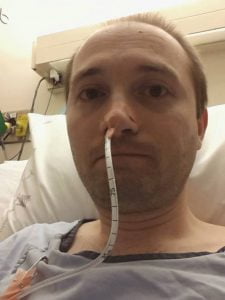
Keep in mind that these may still vary from person to person, but I’ve experienced the following symptoms myself:
- Decreased or no output over a prolonged period of time.
- Unexpected liquid output that’s out of the norm.
- Pain and/or pressure behind my stoma.
- My stoma will retract.
- Nausea.
- Vomiting (this is a very bad sign!! Get to an ER if your blockage has lead to vomiting!).
I find that certain symptoms, like pain and pressure, can come on suddenly, while nausea and vomiting tend to happen much later (like 12+ hours after the blockage started). Again, this may differ from person to person.
Things I Do When I’m Experiencing a Blockage
When I feel that I’m experiencing a partial blockage, I tend to do the following:
- Drink warm water or tea. This not only helps to flush my digestive system, but I find that warm fluid also help me relax (which is important to do in a situation like this).
- I apply gentle pressure around my stoma and massage my abdomen. I’ve been told that many blockages are just behind the stoma, so massaging the area may help to loosen things up and get things moving again. You may find that some areas around your stoma are tender, so be gentle!
- I’ll bend forwards, backward, sideways, and twist; I may also try to bring my knees to my chest (either while laying down or standing). I find that these movements can also help to push things along.
- I may remove my appliance to give my stoma more space to open up. If your appliance is too tight around your stoma, it could cause the flow of your output to be slowed down. This will help when you’re using the massage technique, but I’d suggest hanging a “kitchen catcher” bag off your pant waist so it will catch any output. You might also find that removing your appliance and massaging while under a warm shower can be quite effective.
Other Suggestions
- Some people like to take a warm bath when they feel a partial blockage coming on. If you do decide to have a bath, keep your appliance on.
- A heating pad may also work as an alternative to having a warm bath.
Things NOT to do
- Do not take laxatives. Taking a laxative if you are partially or completely blocked may cause some serious complications. I would also suggest not drinking liquids (like prune juice) if you have a complete blockage.
- Do not eat until the blockage is resolved. As with laxatives, you don’t want to eat when you’re experiencing a blockage. When was the last time you unclogged a toilet by flushing paper towels down the drain? Same situation here.
- Do not stick anything into your stoma unless a healthcare provider has given you specific instructions. Some ostomates who experience frequent blockages may be given a Foley catheter along with instructions on how to use it on themselves, but this should not be attempted without the OK from your doctor, surgeon or stoma nurse.
- Do not ignore pain or vomiting! If you’ve got enough pain that you’re wincing or have vomited, then you should have been at your doctor’s office or ER a half hour ago! Seriously, don’t ignore these signs.
Tip: It may help to keep a special card to keep on you when visiting your ER. This card is available from the UOAA and can be downloaded and printed HERE
Further Reading
You might enjoy some of my past articles detailing my experiences with partial and full blockages. Please, learn from my mistakes!
Question: Have you experienced a blockage? What helps you?



Colonic irrigation is a wonderful option for many colostomates. It had its advantages and disadvantages, but it is definitely worth looking into.
Blockages always seem to produce discomfort, not necessarily pain (which I’ve also had). As things get blocked up, they still need to move, so there will be pressure and discomfort as the output backs up.
I’m probably able to add a field in the user profile where you can select what type of stoma you have, but it wouldn’t be obvious if you were just looking at a forum. I’ll post the question about whether this would be useful feature to have.
What I do suggest is that people write whatever relevant info they like in their profile signature, which will show up at the bottom of every post/reply they make.
Same as what @llholiday suggested :)
stella and LL, from your bio’s, sounds like you both have colostomys. from everything I’ve read, blockages seem to be very rare in colostomys. after 12yrs, I have never had a problem nor have I changed my eating patterns. I have found grapefruit seeds in the bag. a rare kernel of corn. I eat lots of raw veggies and stuff. I did once find a rather long piece of grass in the bag, along with the stringy stuff from corn on the cobb.
from your description, I’d say your system is/was working as normal. if you get flushed out and go to eating light, you are not going to have much output. what goes up, comes down, and, what goes in, comes out. little in, little out. there is a guy over at UOAA that routinely does a colon flush so he can go several days with no output. I’ve had what you described happen to me, Taco Bell I think.
A question for the Ileo’s, have you ever had a blockage with no pain? this seemed to be the important point that was missed?
Vegan, you should try to set up this site with a little icon which indicates if people have an ileo, or colo. from my experience, they are very different in operation and troubles.
@dogtalkerer That is a good idea, identifying the type of ostomy one has – I have just put this information (Colostomy 4/30/2018) on my “signature” line on my profile, so it will show below everything I post.
ps – I tend to “baby” my stoma, I know!
Hi Mimi,
I am so sorry that you went through all of this.
Eating soups that have been cooked a while and soft or pureed foods may help ease you back. I started with broth, then crackers, then soup. I ate lightly for several days and tried not to eat raw veggies until things started to move. It took me about a week before I was back on track.
Regarding bananas, rice and applesauce, though they are soft, they tend to bind as well. These were the foods that my children’s pediatric nurse told me to give them when they had a bout of diarrhea. I hope this helps. Get well soon.
My prayers are with you,
Stella
@sjlovestosing and @mimi, I’m so sorry for jumping in this late.
Stella, that sounds like a blockage to me. I hope that things are now better.
This is definitely a real problem, and not something you could have prevented. I don’t have experience with that kind of restriction, but I’m almost certain that I’ve heard of people who get the narrowing passage dilated to help with this. This might be something to ask your stoma nurse.
Mimi
To help keep output soft the only thing I know that helps are apple sauce and bananas also others have mentioned marshmallows, I know that the marshmallow plant is soothing as is marigold. So I would drink marigold ( calendula) tea, try linseed finely ground not whole seeds with plenty of liquid and also if you can get proper marshmallow leaf as a tea. these will help to sooth and soften. Question is it scar tissue or is it spasms especially as you had okay output for a while?
I can’t see any reason how any these can make it worse and may calm things down.
LLM
Chris