

I had previously written about dealing with thick ostomy output, but many ileostomates have the opposite problem: liquid output. In this post, I’d like to go over a few tips that you can use to thicken up your output. These tips apply to colostomates who have loose stools but are directed more towards ileostomates.
Table of Contents
Video

By playing the above video you agree to YouTube's Terms and Conditions and Privacy Policy
Why Worry About Liquid Or Loose Output?
For the most part, there’s nothing really wrong with having liquid or loose output, but it does come with a few challenges:
- liquid output is more likely to cause leaks.
- liquid output can shorten the life of your wafer by speeding up erosion.
- liquid output can clog pouch filters and/or leak through them.
- emptying a pouch full of liquid can be messy (especially if you have mobility issues).
- liquid output could lead to dehydration more easily.
- a high-output stoma could mean that nutrients don’t have time to be properly absorbed.
- you may need to empty your pouch more often than you’d like.
Causes of Liquid Ostomy Output
Ostomates with Short Bowel Syndrome are more prone to having liquid output with fast transit of their food through their small intestine, but there are other reasons which can cause it too.
Here are a few of the more common causes:
Dietary
The following foods and beverages can cause a dramatic change in your output’s consistency. You’ll likely be able to identify the culprit within hours of consuming them:
- Coffee or tea
- Sport drinks
- Soda/Pop/Soft drinks (both diet and regular )
- Fruit juices
- Chocolate
- Certain fruits (for me, it’s cherries)
- Artificial sweeteners
- Alcoholic beverages (especially wine)
- Fried foods
- Hot/spicy foods
- Non-vegan foods like dairy (or other lactose-containing food, if lactose intolerant)
For the most part, very few of the items listed are needed (or desired) in a healthy diet, so if you can cut them out, you’ll find benefits in more than one way.
Drinking with meals or drinking too much at one time can loosen your output too.
Laxatives, Medication & Supplements
Some medication or supplements can cause our output to become loose. If you are taking a laxative, it may also cause loose stools.
Antibiotics can cause liquid output (diarrhea) that tends to pass within a few days. You may be asked to take a probiotic while you are on antibiotics to help balance out your gut flora. Keep in mind that you should never stop taking antibiotics until you’ve completed the full course.
Viral or Bacterial
There are many types of bacteria and viruses that can cause diarrhea or liquid output. If you’ve experienced an unusual change in your output, you may fall into this category.
Blockage
When you experience a blockage, your body will try to flush out the blockage, which can result in liquid output.
I didn’t have this at all for my last blockage, but many ostomates report having liquid output while they were obstructed.
This will usually be accompanied by other symptoms that are typical for a blockage like abdominal pain, pain with peristalsis (this comes in waves as your gut tries to move things along), nausea and possibly vomiting.
If you suspect a blockage, you’ll want to contact your GI or head to your local ER.
For tips on preventing and dealing with blockages, see THIS article.
Tips for Dealing With Liquid Output
Talk to your doctor if you suspect food poisoning or another bacterial/viral cause of your liquid output. As suggested above, if you suspect a blockage, you’ll want to contact a medical professional.
For “normal” causes, you might want to try the following tips:
Dietary
One of the most effective ways to deal with liquid output is to make a few dietary changes or modify the way you eat.
Keeping your meals and beverages separate, or drinking throughout the day (rather than in one sitting) can help.
The following foods are also known to thicken ostomy output:
- Starchy foods like pasta, potatoes, rice, white bread
- Crackers
- Potato chips
- Applesauce
- Bananas (especially when under ripe and without spots)
- Nut butters (peanut, almond, sunflower seed, etc)
- Oatmeal
Most of these foods can be considered healthy, although, don’t depend too much on the white bread, white pasta or chips if you don’t need to.
I remember one fellow I spent a hospital room with had to consume several bags of potato chips plus Imodium to slow his output down because of his short bowel.
Gelling agents
A popular choice among ostomates is to use gelling agents in their pouch.
These can come in tablets, powder, capsules (usually made with animal ingredients) or sachets, but they all work in a very similar fashion: Add the gelling product to your pouch as directed and it will thicken up when it comes in contact with your output.
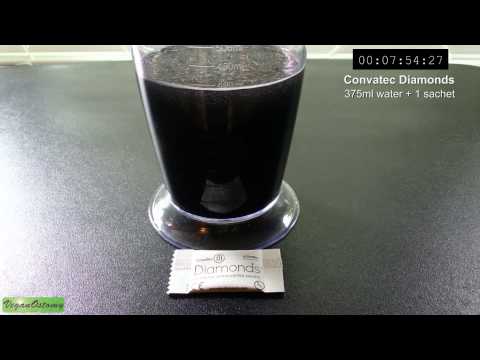
Here’s a demo of how gelling products work:
By playing the above video you agree to YouTube's Terms and Conditions and Privacy Policy
I’ve reviewed the ConvaTec Diamonds sachets, but I’ve also tried other products and they generally work well. You should be able to get samples to try.
Anti-Diarrheal Medication
Many ostomates will be told by their doctor or stoma nurse to take a product like Imodium to slow down their output. I would personally try this last if all other options failed, however, if you have a very high-output stoma which is causing ongoing nutritional problems or dehydration, this might be an option you’ll want to try until things get stabilized.
Fibre Supplements
This is not an option I’d recommend, nor is it something that your doctor is likely to recommend either. There are fibre supplements which can bulk up stool but they carry a risk of causing a bowel obstruction too. Do not try this unless explicitly told by your doctor.
Guar Gum
Guar gum is made from guar beans, but it’s been used as a thickening agent in various products for quite some time. There are claims that it has eight times the water-thickening effect compared to cornstarch, which is pretty impressive!
As a supplement, this often comes in tablets, but you should consult with your doctor to see if it’s a good option for you. Like fibre supplements, there’s a risk of slowing things down too much.
Consider Using a High-Output Appliance
If you find that your liquid output is difficult to manage when you’re wearing a traditional ostomy pouch, consider a high-output appliance.
These styles of pouches have larger capacities and are designed to better manage liquid output.

The product in the photo above is one of Coloplast’s high-output appliances. I did an overview of them HERE, and it may be an option worth considering.
Closing Thoughts
Some ostomates don’t mind liquid or loose output.
But if you’re one of the people who find liquid output to be problematic, then I hope the suggestions listed will come in handy.
In addition to the tips included above, you may also want to try using barrier rings or moldable wafers to help prevent liquid output from leaking under your appliance.
QUESTION: What do you do to thicken your output?



New one on me, the causes suggested are worth looking at, could it be a different or new food I know beetroot will look a little scary when passed !
I’ve experienced strange colors in and under my wafer, and that tends to be normal. Not mold.
I did at one point think I had “mold" on my wafer, and it turned out that the blue marker I was using simply transferred the ink onto the wafer when I was drawing a hole to cut, and subsequently ended up getting on my skin. That was alarming at first until I figured it out.
Continue to have your mom keep an eye out and if she believes there may be a problem, perhaps schedule her to see a stoma nurse to have a look.
Can you get black mold in your Ostomy bag? My mom has one and on the in side of the bag looks like black mold.
@HannahHannah, I think this is an interesting question. Does your mother use M9 drops? I have suspected that they turn my output black – not complaining, because it is such a great product – but I have wondered.
@llholiday
That’s a great point, too. M9, or any other colored deodorant, may also cause blueish/greenish staining.
@HannahI know what you are talking about Hannah. I find anytime I eat any strong coloured fruit or vegetable especially, I get that black thing look in my pouch too. It is looking like spots or wide spread. I find when I eat something like green beans, especially canned ones, or regular beans, sticky type foods, the pasty sort will do this too. Spinach & artichoke dip the spinach does it every time. Beets are a color changer to the bag and so does cheese of any kind for me. We can get a fungus under our wafer if it is in moist conditions and does not dry up the way it should and usually does but that is usually if there is a leak not tended too. No on the mold I say. Plastic stains and the M9 is a strong color all around, it stains my clothes if I get some on it. I just see your last entry came in on my phone, I am on the lap top. so I will send this to you now. Greens Asparagus, Broccoli, grapes, candies with strong colours, Popsicles, also have changed it even…..
Hello Sue, welcome to this site. Runny and a colostomy should be checked out by your doctor. For me, it was a little hard to deal with odor when the smell no longer comes from behind us… to me, it felt like it was right in my face and to be honest is was the kind where my hubby would fart and toss the blankets over my head and hold them there! Maybe try keeping a journal of what you eat to try and figure out the smell thing. Veggies such as Broccoli always makes mine stinky to some extent. Also, you can buy from Hollister a bottle of M9 liquid deodorant to put in your bag. They have a nice size sample to send you also, so feel free to call them and ask for a sample. The big bottle is about 40 bucks in Canada, and I get a month out of one, I use 20 drops per empty. Count them out, it helps make them last the month and it is worth the expense to me. I ave an ileostomy, also ask for a sample of the “room" spray deodorizer to try, they booth work well to help to omit odor. I tend to find that there is something about the M9 that seems to even minimizes the odor of gas you may release from the pouch too. Have you looked in to the Osto EZ Vents ( Eric has a video here on this also) to attach to your pouch? This too is worth the cost but not necessary. All the best and don’t be shy here.
I have had a colostomy for 2 months and my output is brown water and very stinky. I can feel the watery poop coming out. What can I do about that?
@Sue
Hi Sue, there could be many reasons and solutions for what you described.
You’ll need to find out why you’re having that kind of output before you can move towards addressing it.
Smelly and watery could indicate several things, but you may have to consult with your doctor or nurse to confirm. If you are taking any antibiotics, or going through a cancer treatment, you may have that kind of output.
It could also be diet related.
There’s a lot to consider, so I hope that you’ll be able to connect with your doctor or nurse for more help.