

When I had tested the one-piece SenSura Mio appliance, I was a bit disappointed but found enough strong points to recommend it to most ostomates. The two-piece system has been something that I’ve been looking forward to trying, and here’s my review!
Disclosure: This review is based on samples I received through the Coloplast customer service dept, as well as samples received during a patient feedback program. No other compensation was provided, and both my experience and opinions are completely my own.
Table of Contents
Video Review
By playing the above video you agree to YouTube's Terms and Conditions and Privacy Policy
About the Sensura Mio Click
Products I’ve used for this review
Product name: SenSura Mio Click baseplate
Manufacturer: Coloplast
Product #: 10502
Dimensions: 10-35mm, Cut-to-fit, flat wafer with 40mm coupling
Quantity per box: 5
Product name: SenSura Mio Click Narrow Outlet Drainable pouch w/ filter; opaque.
Manufacturer: Coloplast
Product #: 11432
Dimensions: 40mm flange coupling
Quantity per box: 10
Product name: SenSura Mio Click baseplate
Manufacturer: Coloplast
Product #: 10512
Dimensions: 10-45mm, Cut-to-fit, flat wafer with 50mm coupling
Quantity per box: 5
Product name: SenSura Mio Click Wide Outlet Drainable pouch w/ filter; opaque.
Manufacturer: Coloplast
Product #: 11472
Dimensions: 50mm flange coupling
Quantity per box: 10
The Sensura Mio Click is an inspired ostomy product line by Coloplast. It holds an impressive feature set and style that sets the bar for what an ostomy appliance should strive to be.
The SenSura Mio Click line comes with a staggering number of options, from opaque to transparent, filtered to filterless, wide outlet to narrow outlet, closed-ended to drainable, flat wafers and convex – you get the idea right? It’s a complete line that caters to any ostomate, including urostomates.
Coloplast is good when it comes to providing a complete package for ostomates, and the wafers are packaged with a reusable stoma measuring guide; the pouches come with small garbage bags and filter stickers.

The Wafer
The SenSura Mio Click wafers I’ve used are cut-to-fit, which means I have to measure my stoma and cut an opening to fit through the wafer.
These wafers are really easy to cut, and they have measuring guides that you can use if you know your stoma’s size before hand.

They do come with a single release liner, but the wafers are not individually sealed, which I find more difficult to carry in my travel bag.
For those looking for added security, the wafer does have four belt hook loops (vs. two you’d find on most other appliances), but it requires a special four-hooked accessory belt to take advantage of.

One of the benefits to the Sensura Mio Click is that the wafer is highly flexible and will work well with many body shapes.
Patients with hernias, for example, may find that the Mio will form-fit along curves better than some of the more rigid plastic wafers.
The thing that I like most about the Sensura Mio wafers, is the fact that my skin does really well with them!
I don’t find any irritation under the wafer or around the edges of the wafer (which were a problem on the Xpro and Assura line), and the skin around my stoma remains intact and healthy.
My results are great even without the use of barrier rings, barrier wipes, stoma powder, or anything else to help my skin. Kudos to Coloplast!
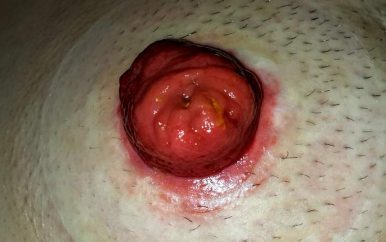
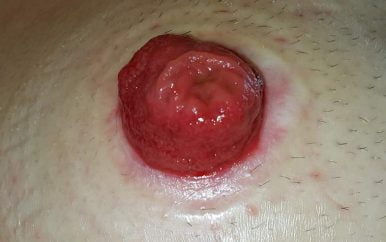
My wear time has been a consistent three days with zero to minimal wafer erosion.
This is actually much better than I had expected, and it did perform better than the one-piece; I experienced NO LEAKS while using these wafers.
Unfortunately, wafers in the Sensura Mio line are manufactured using gelatin, so these would personally not be a product I’d choose first, since I have alternatives that are free of animal-based ingredients.
One can only hope that Coloplast will replace gelatin in the future.
Info: The SenSura Mio is also available in convex, although it’s not a style that I’ve tried before.
The Pouch
I’ll be honest, the SenSura Mio bags are the best looking ostomy bags on the market right now, and they are the only one I’d confidently wear without a pouch cover.
The fabric cloth that’s used on the product is unlike anything you traditionally find on an ostomy bag.
The color is a neutral gray, and it does a great job of repelling water; I often find that after showers it takes very little effort to dry my pouch, and it would often be dry before I even finished using the bathroom.

Unlike many other brands that use opaque cloth bags, the fabric used on the Mio is durable and modern looking, and it’s nice and smooth.
As a bonus (which really should be a necessity on any opaque pouch), the fabric conceals the contents of my bag quite nicely.
The Mio Click, like many other Coloplast products, comes with a mechanical coupling that uses a locking mechanism to secure the bag. The style of the lock is slightly different from the SenSura Click, and it’s been improved to allow for easier access in a more reliable design.
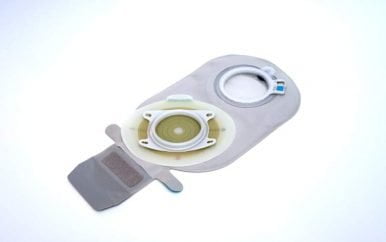
The lock does add a bit more bulk to the appliance, but when unlocked, it allows you to easily rotate your bag horizontally or diagonally before locking it back into place.
This is something that you’d have trouble doing on other appliances since freely rotating the bag isn’t as easy as it is with the Mio, and it’s often less reliable.

By playing the above video you agree to YouTube's Terms and Conditions and Privacy Policy
While the mechanical coupling on the Mio is great for convenience I found that it was useless if I needed to burp my appliance to release gas from the coupling. Attempting to burp my appliance basically causes the bag to completely come off!
I was over a toilet the first time I tried that, but I can’t imagine what kind of trouble I’d be in had I attempted that in bed on in my car! If you must burp this appliance, do it from the outlet while laying flat on your back.
Coloplast offers both a wide and narrow outlet to the SenSura Mio Click, with the narrow outlet designed specifically for ileostomates (I’ll refer to this as the “ileostomy bag” throughout the rest of the review).
The narrow outlet pouch differs from the wide outlet version in a few ways, which I’ve detailed in THIS post.
Basically, you have no velcro tabs from which to hold the outlet flap open while you empty your pouch, and you also have a different filter design, which I’ll explain more of in the next section.

While I do prefer the wide outlet, the exclusion of the Velcro tabs on the narrow outlet bags really made it difficult for me to empty my pouch, or clean it without getting my hands dirty (quite literally!).
I’m sure ileostomates with liquid output might find it easier to empty with this design, but I found it quite a challenge that easily added another 20 seconds to my routine as I struggled to clean the opening and the flap.
You will still find Velcro fasteners at the end of the outlet, which keeps the outlet securely closed, and you can tuck that outlet neatly on the bottom, or fold it in half for a more compact look.
Like the one-piece, I really appreciate the attention to detail on these bags, and you can easily find the model number and lot number on the top of the pouch, under the fabric flap.
A nice touch that Coloplast added to the Sensor Mio bag is the inspection window which allows you to see what’s happening inside your pouch without having to resort to wearing a clear pouch.

The Filter
As I mentioned previously, the wide and narrow outlet bags both feature different filters, or more accurately: pre-filters.
If you look closely at the two styles, you’ll notice the wide outlet pre-filter has many small holes in it; this can help to remove gas from your pouch, provided your output is dry enough not to clog it up!
The narrow outlet bags have pre-filters with only a few holes, and that should help to keep ileostomy output from clogging it.
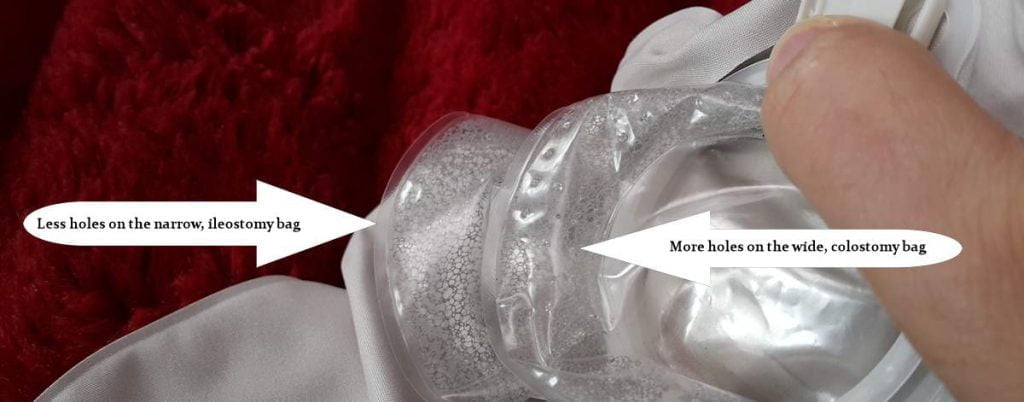
But does it work??
I do find that the ileostomy bags work better than the colostomy bags (wide outlet bags) when it came to minimizing ballooning, however the results are still inconsistent; I found that on certain days I would have pouch balloon within 24 hours, while at other times I could go a full 3 days without ever having any pouch ballooning.
Tip: If ballooning is an issue with these bags, considering using the Osto EZ-Vent. I’ve got special instructions on how to get it working with this bag HERE. I’ve also got an entire article on ways to prevent ballooning HERE.
Since my output tends to be thick (for an ileostomate) this is a little concerning as I know that liquid output will probably clog this filter up much faster than the output that I’ve got.
I’m also not a fan of the large pre-filter that either of these pouches come with. One of the reasons for this is because I find that no matter how empty my pouch is, it always feels like it still has something in it.
This happens because over time the pre-filter will collect fluid without giving it any place to go so it’s basically like you’re carrying a sponge in your bag.

For some, the feeling this causes may be annoying, considering you have to wear an appliance 24 hours a day, and I do find it frustrating to have to double-check and triple-check to make sure that my bag really is empty.
I would have preferred no pre-filter and simply a small filter like what you’ll find on Hollister, ConvaTec, B. Braun and other ostomy bags. While there is an option to go with a filterless bag, this defeats the purpose for anyone who has ballooning issues.
There is one advantage to having a pre-filter, though, and it’s the fact that I’ve never noticed the pouch sagging when it got full.
But the large pre-filter is also a problem if you’re the type of person who wears stoma guards. Some stoma guards simply don’t have enough room for everything to fit under them comfortably with pre-filter there – it’s overcrowding, to say the least!
Some ostomates may also find that the large pre-filter creates pancaking issues or makes pancaking worse for people who already struggle with that problem. I noticed this happening a lot, where I wouldn’t normally notice it on other appliances.
One thing I do need to point out is that the outer filter is not waterproof, so you do need to use the included filter stickers if you plan on having a shower or going for a swim with this appliance; not covering the filter can lead to water clogging it from the outside.
Conclusion
At the time of this writing (Dec 2015), the SenSura Mio Click is available worldwide. I find that the prices on these are about average, but still more than a one-piece.
Coloplast is great for sending samples, and you can request them from your local Coloplast office.
Pros:
- Comfortable.
- Gentle on the skin.
- Flexible wafers.
- Locking mechanical coupling is very secure.
- The pouch fabric is in a class of its own, both in quality and aesthetics.
- The inspection window is a really nice touch.
- The velcro closure locks are convenient and secure.
- The fabric cover is the most water-resistant I’ve seen on any appliance.
- Available pretty much everywhere.
- The filter on the ileostomy bag does work fairly well.
- The wafer is easy to cut and contains a measuring guide on the release liner.
- Wafer holds out great during showers.
- Wafer held up very nicely, even after 3 days.
Cons:
- I found the lack of velcro tabs on the ileostomy bag to be challenging.
- Contains animal ingredients.
- The large pre-filter can feel quite bulky.
- The pre-filter often exaggerates pancaking.
- The pre-filter makes it hard to wear a stoma guard.
- Can’t burp the bag from the coupling.
- The outlet flap on the narrow outlet often makes it difficult to clean.
Recommended
The Coloplast SenSura Mio Click is a well-rounded appliance, and you can tell that a lot of work went into the design of this product; it’s worth checking out if you didn’t have much success with the one-piece Mio.
For those who have been disappointed with the filter performance on the wide outlet bags, you will have the option to use the ileostomy bags for better results.
While the system does have a few flaws, mostly coming from the size of the pre-filter, may ostomates may overlook them in favor of the next-level fabric and design.
Info: For more information, please visit the Coloplast website at www.coloplast.com
Bonus: A Review on the Convex Urostomy Mio Click System
The following review was shared to me by a urostomate, Stephen, who’s been able to write about his experience with the Convex Urostomy version of this system. This is information that I could never provide first-hand, so I am grateful for his effort in putting this together.
Bag pt no. (11498), backing plate pt no. (16911)
I recently trialed a couple of new products from the new SenSura Mio convex range of urostomy bags, the result of suggestions made during a meeting with my stoma nurse about my slightly recessed stoma. Up to this point, due to issues with non convex Hydro Colloid bags, I had been using microskin bags.
The most recent bag I trialed was the SenSura Mio 2-piece “click” convex urostomy bag. I received as samples two convex light baseplates and four clear “click” bags (I much prefer clear bags, as it’s much easier to check on what’s happening with my stoma).
Due to the built in plastic cup the baseplate really is quite bulky, protruding somewhat and making it visible under tighter fitting trousers. However, I found the “soft seal” element of the baseplate made it relatively flexible, and I experienced no discomfort. Adhesion was excellent and remained so even after a bath (bathwater also just ran off the fabric backing of the bag).
I did find that enlarging the hole to accommodate my stoma required accuracy, there is little room for error, so I left this to my wife! (in the long term it may make sense to use Charter’s pre-cutting service). Placing the baseplate was quick and easy, with very few wrinkles in the adhesive backing requiring smoothing out.
After reading the instructions fitting the bag to the baseplate proved easy and the locking ring easy to operate. Ease of operation of the locking ring was a feature I particularly liked, easy to secure the bag preventing it from slipping and easy to unlock and rotate the bag to any angle I wanted, for example to 45O when I connected the bag to a leg bag before I went hiking. Removing the bag to clean/flush it out, clean the plastic cup of the baseplate and my stoma proved relatively quick and easy, which is something you can’t do with a 1-piece bag, (just remember to tuck a plastic bag into your waistband to catch output while you do this)
Degradation of the hydro colloid part of the baseplate at 96 hours before replacement was much better that I had experienced with non-convex hydro colloid bags, where the wear time had been as low as 10 hours! I used two bags per baseplate, replacing the first bag after approximately 48 hours.
After trialing the new SenSura Mio 2-piece “click” convex bags, I am happy enough with them to have requested a batch on my most recent prescription order for use as my main bag. I will however still be keeping a small supply of microskin bags as well.
Stephen


Wanted to clarify: anywhere you can get the Mio opaque pouch with inspection window (best of both worlds!). There is still one filterless Mio available in transparent (11474).
The video on how to put the 2 piece bag together is sort of misleading as it is quite easy to put it together OFF your body but I found it impossible to put together ON my body. If anyone has a suggestion for me I’d love to hear it as I am using the one piece now but would much prefer the two piece.
@Diane
Hi Diane. Which brand and model are you using? I use Hollister New Image 2pc and only ever connect it when the wafer is already on. They are designed to be easy to do that for people who change their bags more frequently than their wafer.
Coloplast SenSura® Mio Click #18500 with pouch #11463
Hi Diane,
Those are the Concave products, which I haven’t tried myself, but the coupling looks to be the same as their other Mio Click products, so they should still snap together. My suggestion would be to make sure that the locking mechanism on the coupling is unlocked when you try to snap them together, but it’s entirely possible that if the coupling is curved while on your body then it may not line up very easily.
Ahhh, I never thought of the convex curve causing the problem. Perhaps that is it. Thank you for this site, it has answered more questions than were answered during my almost three months in the hospital! The one piece convex (not concave) is what I am using now and it seems fine. The 18500 is convex not concave, by the way.
Hi Eric, I’m commenting here, even though I prefer 1-piece systems, because this is where you wrote the most about the Mio pre-filter and its connection with pancaking. I’ve had my ileostomy for 27 years. I used a Hollister system for most of that time, but stopped a few years ago after they made some changes, which apparently included a change in formulation of their Flextend barrier. I started using Sensura Mio in 2017, specifically model 10482, a 1-piece system which, like almost all Mio pouches, includes the big full-circle pre-filter. It seemed to work well at first. But in 2018, I had 4 major pouch leaks (or blowouts), including an embarrassing one at a social occasion. The last 3 of those leaks occurred within a 2-month span. On analyzing them, I decided they probably involved pancaking on occasions when my output got thick, and the huge Mio pre-filter may have acted as an obstacle that prevented the thick output from spreading away from the stoma area. So I decided to switch to non-filtered Mio pouches (specifically model 10492, which is identical to 10482 but without the filter). I’ve been using these non-filtered pouches for more than 7 months now and haven’t had any more leaks. Maybe it’s too soon to be absolutely certain, but it looks like I’ve solved the problem.
Eric, you wrote that you’ll get leaks due to ballooning but not pancaking. I seem to be the reverse. I’ve had serious leaks associated with pancaking but never any leaks from ballooning. Obviously, I get ballooning occasionally since I’m using non-filtered pouches now, but it hasn’t ever caused a leak. And interestingly, I think I got just as much ballooning when I was using filtered Mio pouches, suggesting that Coloplast’s highly touted Mio filter didn’t prevent ballooning in my case. (By the way, during all the years I used Hollister, I was using non-filtered pouches. During those years, I occasionally woke up with a scary high-pressure balloon on my belly, but it always stayed intact long enough to reach the bathroom and empty — never caused a leak.)
My main concern now is that Coloplast makes so few Mio models without the filter. The model I’m using (10492) can be found on Coloplast’s US website but not their Canadian website. And it seems that Coloplast’s websites for some countries don’t include any non-filtered Mio models at all. I hope they keep making the non-filtered pouches I’m using.
Thanks for sharing that, Bob! Glad it’s been working for you!
I should add that most of my leaks are from ballooning at night, but pancaking has probably been responsible for several leaks, I’m sure. That said, I can’t even recall the last time I actually had a leak. My appliance (2pc Hollister w/ CeraPlus) has been extremely reliable.
I can only guess that filtered models are more popular, even if they don’t work for everyone.
If you are feeling adventurous, you CAN cut out the large pre-filter from the Mio bags, and then put a sticker over the outside of the filter from the outside of the bag – it’s a bit of work to do this, so it’s not a very long-term solution.
Eric, thank you for replying so quickly! You wrote: “I can only guess that filtered models are more popular, even if they don’t work for everyone."
Well, Coloplast has been promoting their full-circle filter very strongly. See their video at https://www.coloplast.us/global/ostomy/convex-launch/convex-innovation/?section=The-pre-filter-is-the-key_391002 And they seem to think it’s such a great innovation that they’re putting it in nearly every Mio model. It’s possible that this pre-filter is causing problems for a lot of people who have no idea that it’s a problem. Sometimes it’s pretty obvious, as in Gail’s case below. It wasn’t so obvious in my case. I was getting occasional major leaks for no apparent reason, which was very frustrating. Finally, I figured out that my leaks seemed to be related to pancaking caused by the Mio pre-filter.
You also wrote: “If you are feeling adventurous, you CAN cut out the large pre-filter from the Mio bags, and then put a sticker over the outside of the filter from the outside of the bag"
Since I had saved one of the filtered Mio pouches that I used to use, I’ve examined it to see if this would be possible. I decided that with the 1pc model I used, it wouldn’t be possible to cut out the pre-filter without destroying the pouch. But it might be possible with a 2pc.
Hi Bob, yes, with a 1pc you would have to have a large hole already cut in the back to even have a chance to cut out the pre-filter (I wouldn’t even attempt it in that case).
But it seems like that pre-filter “should" work better for people who have a colostomy (dry, infrequent stool). For us with ileostomies, it just soaks up fluids and fails quickly.
Currently experimenting with appliance combos and have several thoughts and questions on Mio 2 piece. I’m still healing and have long stoma so sticking with 2 piece systems for now. Used Hollister with CLIPS while inpatient but ordered the lock and roll once I got home. I’m still at the stage where I want to see my output and stoma as its early days (and actually will likely prefer to always be able to see stoma). Ordered Hollister transparent and they changed the material! It’s now this thin crinkly plastic that extends to the spout, is hard the clean and does not inspire confidence! Apparently this is also what you get if you order ultra clear as well. Anyone else notice this change in material?Back to Mio click 2 piece: -Love the feel of the bag, ability to roll cuff, and locking mechanism-super difficult to attach bag to wafer on skin as others have noted and unable to rotate once on even when unlocked (will try water as Eric suggested next time)-I have very thick output despite hydration and the prefilter is a recipe for pancaking. I cover the small filter on day one to allow for air but that huge prefilter sucks! It just sits there collecting shit around the stoma. I’d love a filterless option that I can attach the EZ vent to. Question: is the Mio Click pouch available anywhere without a filter?(interestingly, only the wide spout maxi (11473) are available in the US, not the narrow Eric mentions. I think this is ok though as I like the little Velcro tabs that hold back the spout protector). I need to see how the Coloplast wafer treats my skin then decide between the Hollister (would need to to opaque given the new flimsy fabric) and Coloplast and deal with the prefilter issue. So confusing!
I am under the impression that they have done away with the narrow spout bag altogether.
Hi Amber, depending on where you live, you have both the wide and narrow outlet options available. We still do here in Canada as of Dec 2019.
@AmberYes, only the wide spout is available now in the US. I have nothing to compare it to other than the Hollister New Image products but I don’t have any issues with the size of the Coloplast “wide” spout. Also, unlike the narrow spout, this model comes with little Velcro tabs to hold the end flap open which I really like. I have thick output so maybe with liquid output a narrow spout is more desirable but I would give the wide a try if in the US. Good luck!
I wrote 8 months ago that I switched from filtered to non-filtered Sensura Mio pouches after suffering several major pouch leaks which seemed to involve pancaking due to the Sensura Mio pre-filter. Now, some follow-up: After switching to the non-filtered pouches, I haven’t had any more leaks. However, I’ve had several NEAR leaks recently, where, during a regularly scheduled change, I discovered that it was very close to leaking, and a serious leak would have occurred if I had worn it just a little bit longer. Moreover, after reviewing all the data, I’ve determined that, in addition to the effect of pancaking and the Mio pre-filter, there’s a second factor which has contributed to my leaks:
The issue is that SENSURA MIO ADHESIVE HAS A SHORT SHELF LIFE. And, even when it hasn’t hit its expiry date yet, if it’s sufficiently close to its expiry date it can lose enough adhesion to increase the chance of leaks. Coloplast knows that Sensura Mio has a short shelf life, as they mark each box with a shelf life of only 2 years. (See the post about expiry dates at https://www.veganostomy.ca/ostomy-product-expiry/ and note the photo of box of Sensura Mio 1pc drainables). This is in marked contrast with Hollister and ConvaTec pouching systems, which are considered to have 5-year shelf lives. I’ve worked through all my purchase records of Sensura Mio pouches, which include the expiry dates of every box. I found that every time I’ve had a significant leak or near-leak, with either filtered or non-filtered Mio pouches, I was using Sensura Mio adhesive that was within 10 months of hitting its expiry date (or, equivalently, was older than 14 months after its manufacture date).
Given this information, I’d like to be able to instruct my supplier not to sell me any product that’s within 10 months of expiring. But that isn’t possible (All I can do is make sure they don’t sell product which has actually expired). What I’m doing now is choosing how long to wear each pouch based on its expiry date. Previously, I typically wore (one-piece) Mio pouches for 3 or 4 days. Now, I still wear them for 3 days if they have more than 10 months to go before hitting their expiry dates. However, if pouches are within 10 months of expiring, I wear them for only 2 days. I’m also being very careful to always use up older products (by expiry date) before newer products. Thus, if I get a newly purchased box which happens to be older (by expiry date) than a previously purchased box that I’m still using, I’ll immediately switch to the newly purchased box and use them up before returning to the previously purchased (newer) product.
While this is working, for now, it’s annoying to deal with a product that has such a short shelf life and sometimes get so little wear time. Therefore, as much as I like the Sensura Mio systems, I may hunt around to see if I could use a system from Hollister or ConvaTec with their more sensible 5-year shelf life.
Hi Bob. Thank you for the update!
I can certainly see how that can be a problem and I’m not sure that anything can be done unless the Mio’s adhesive formulation is changed. Good luck, and I hope you find a solution that works better for you.
On changing the adhesive formulation, the Sensura Mio adhesive has some unique characteristics in terms of its elasticity and flexibility as shown in the video at https://www.coloplast.ca/sensura-mio-1-piece-drainable-en-ca.aspx#section=videos-and-animations_100 and it’s possible that in designing an adhesive with those characteristics, one of the trade-offs was a short shelf life.
Gail, welcome to you too. Try and pic up the amount of fluids you drink. Drink before during and after your meal as well. It can help combat some of the thickness you are experiencing. I also found eating a salad in between bites of regular foods, helps a lot with thick output. With your last glass of fluid after your meal, remember to drink between meals too. I try and swish up my food with the fluids by swaying it with my torso. Weird, I know, but it has worked to mix it all up and I can not remember the last time I had that kind of thick output after I increased my water in take. (All things considering ofcourse. ) Be careful not to hurt your new incisions, so go gently. I hope you find what works. Be well.Linda
Hi Gail and welcome to the forum,You could also just use a filterless bag ( whatever you are using that works for you, but get a model without an integral filter) .Then attach and Osto EZ-Vent. Do them in batches.There is info about Osto EZ-Vents on Vegan Ostomy. While this does add some time ( installation) and costs ( you usually have to purchase them …amazon carries them) they have made my ostomy MUCH easier to deal with. Its a small plastic contraption that you attach to the bag . It has a thing that you can lift out ( like on a beach ball) to vent the gas. So helpful , especially at night.I use the Hollister two piece system. I used to get the bags that came with the filters, but they really don’t work very well, and actually leaked FROM the vents after four or five days .. NOT the desired outcome.Anyway, welcome and keep asking questions. I don’t know if they help with pancaking ( your original question) but they make it easy to avoid ballooning. For me pancaking occurs if I eat to much ‘grainy’ stuff. Nuts, seeds, dry crackers. Especially late in the day where it will be a problem later at night when I am laying down.