

A crucial skill that anyone with an ostomy should know is how to measure their stoma. Not only does it help to prevent leaks, but it can help to extend appliance wear time, and save your skin!
This guide will explain what supplies you’ll need, as well as show you how to properly measure your stoma and cut your wafer.
Tip: If you are a new ostomate then it’s very often recommended that you measure your stoma with every appliance change for at least the first month to six weeks. That’s because your stoma will be shrinking during that time.
Table of Contents
Video

By playing the above video you agree to YouTube's Terms and Conditions and Privacy Policy
Who This Guide is For
Ostomates who will benefit the most from this guide are ones who have an uncomplicated, round-ish stoma that is slightly protruded.
The process is very similar for ileostomates, colostomates, and urostomates who use cut-to-fit appliances.
If you have a recessed, flushed, or prolapsed stoma, then you may not get perfect results by following this guide.
Things to Note
You would think that putting together a guide on how to measure a stoma would be pretty straight forward. Unfortunately, there are a few things that make this difficult:
Loop vs. End Ostomy
Due to the “double-barrel” nature of a loop ostomy, it may not be possible to measure the stoma using a circular guide.
If you have a loop ostomy, you may need to be creative about how you measure your stoma. One suggestion is to use a half circle, rather than the full circle of the measuring guide and measure each part (or each half) of your stoma separately. You can then trace that onto your wafer.
Every Wafer is Different
Not all wafers will act the same when they are worn. While all wafers tend to swell a bit as they come in contact with fluids or output, the degree in which they swell can differ from brand to brand.

Because of this, you may need to cut your wafer slightly larger to accommodate the expansion. Doing this also helps to prevent the wafer from “strangulating” your stoma by putting too much pressure around it.
Another thing about wafers is that they come in all kinds of sizes and materials. When I buy wafers, I try to get a size that allows for about 1cm of space between my stoma and the edge of the cutting lines (or up to the flange ring on my 2pc system).
If you use a wafer that doesn’t give you enough space, you may end up having difficulties cutting it, or worse, develop leaks.
There’s no harm in getting a wafer that larger than you need, and you may be able to get more pouch support because it has more surface area to stick to.
That is, of course, provided that a large wafer fits well on your skin (there is such thing as having a wafer on that’s too big!).
Stomas Can Change
As our bodies change and so do our stomas.
It’s expected that your stoma will change its size (get smaller) for the first four to six weeks after surgery due to the swelling that occurs post-op.
Likewise, weight loss/gain can change the size and shape of your stoma, and so can things like a prolapsed stoma or a hernia.
My stoma fluctuates between 28mm and 32mm at various times, despite being over three years out from surgery. Stuff like this happens!
While you won’t able to control or predict these changes, you can make sure that your wafer is cut as accurately as possible.
Info: For more information on why stomas can change their size or shape, please refer to THIS article.
What You’ll Need
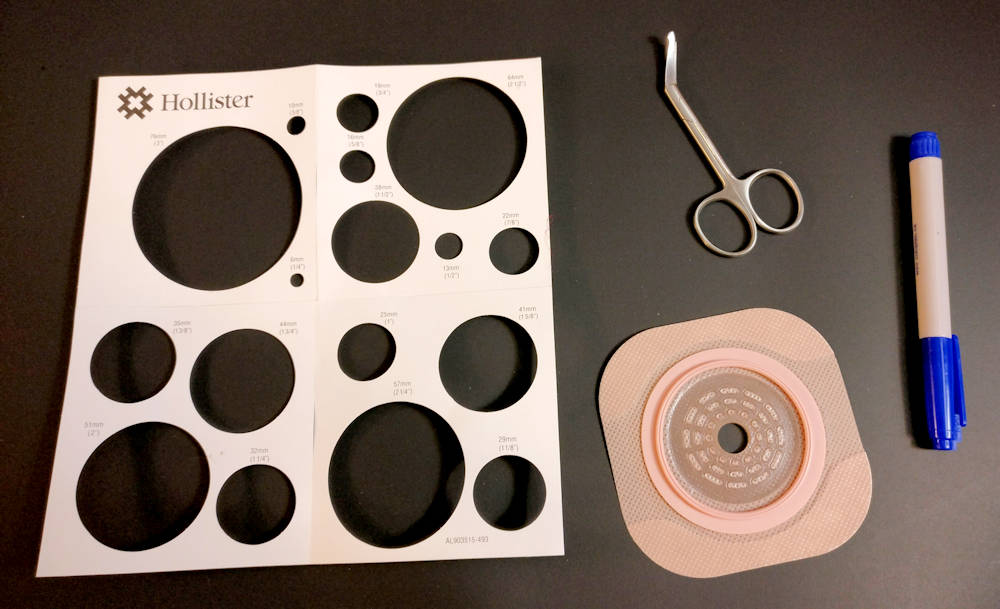
These are the supplies I like to keep on hand, but depending on the appliance you’re using, some of these won’t be necessary.
- Stoma measuring guide. If you’re using a cut-to-fit wafer, these will almost always come in the box of wafers.
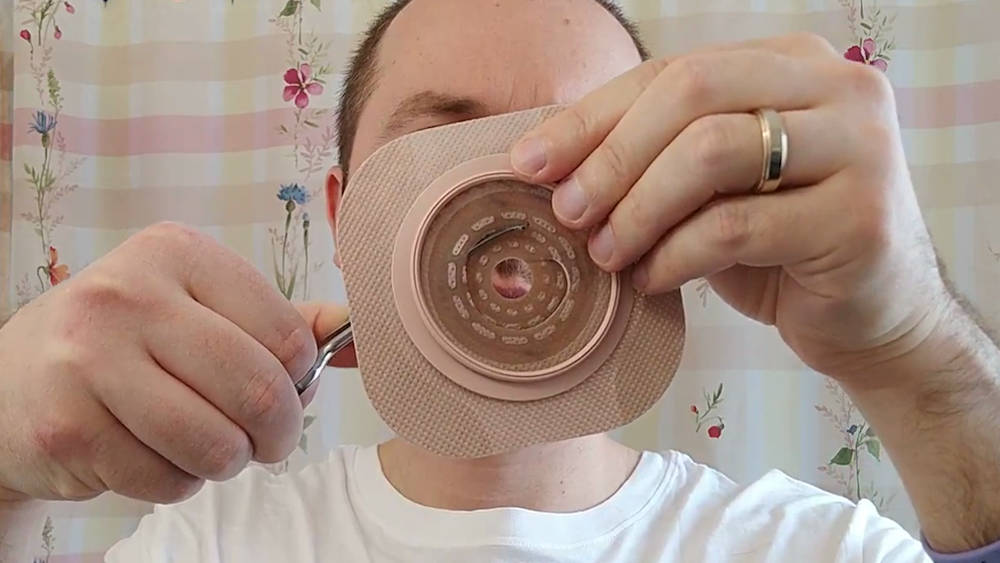
- Ostomy wafer scissors (don’t use regular scissors, cuticle scissors, or anything with a sharp tip). I use and recommend THESE (Amazon affiliate link).
- Pen or marker for tracing.
- Your wafer (obviously!).
- Gauze (optional) to dry your stoma. I prefer gauze over toilet paper/paper towel because the latter tend to break apart when wet.
- Mirror (optional, but recommended). This can help to see under your stoma while measuring it.
Some wafers will come with cutting lines printed on the back, while others do not. If your stoma is a consistent size, feel free to cut the wafer according to the cutting lines without the need to measure and trace the hole.
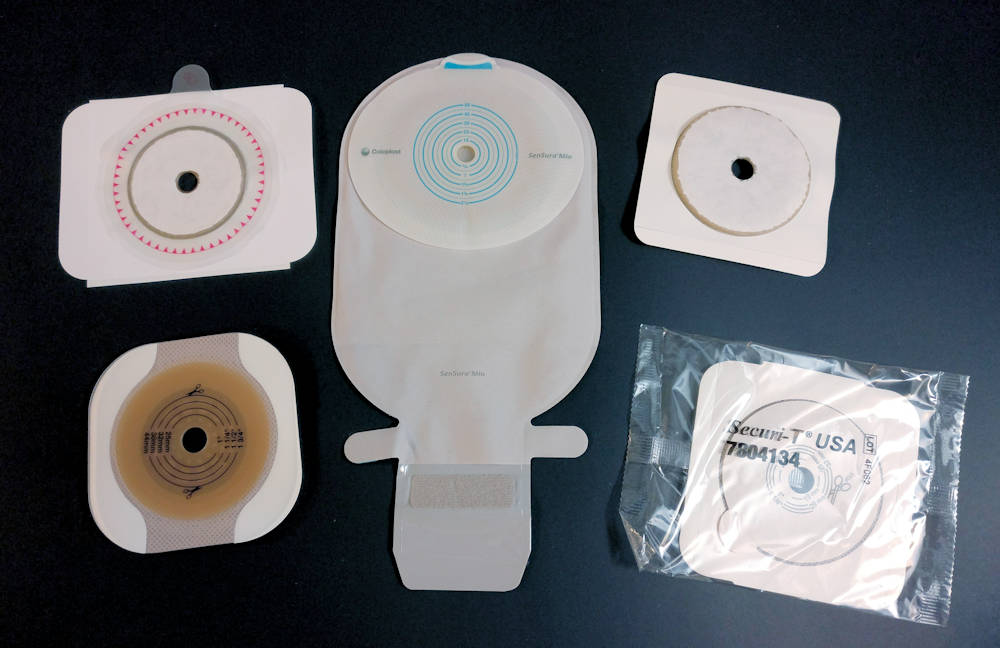
Steps to Measuring Your Stoma
- Gather your necessary supplies.
- Empty your bag and wash your hands.
- Remove your previous wafer then shave, clean, and dry the skin around your stoma.

- Take your stoma measuring guide and find the approximate size of your stoma or use the previous measurement.
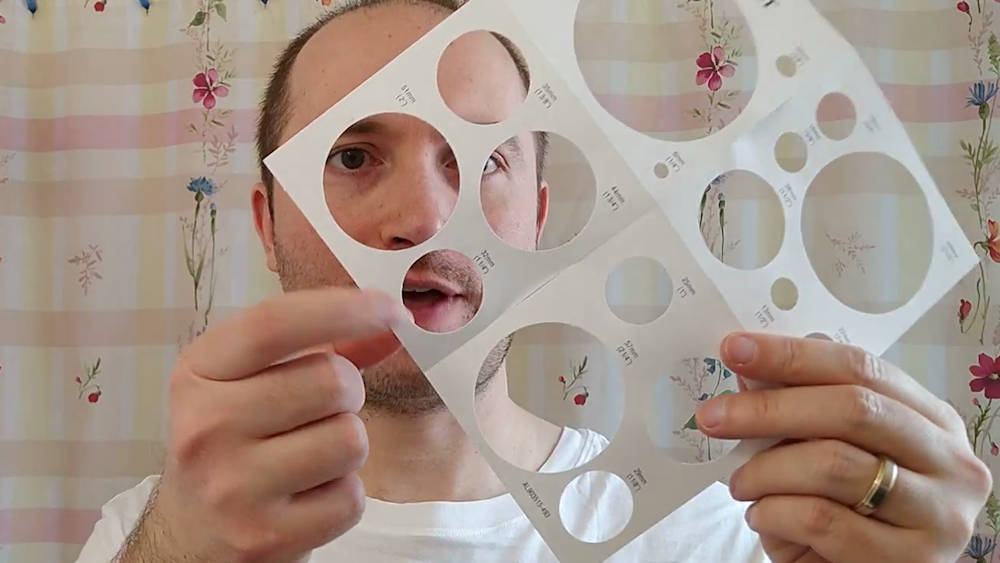
- Place the guide over your stoma so that your stoma goes through the hole.

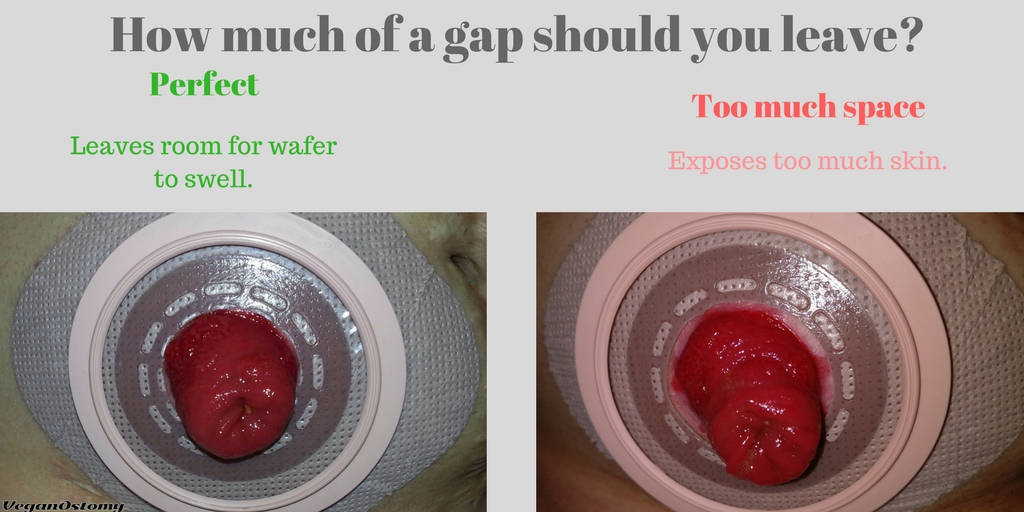
- You’ll want to make sure that there’s about a 1/16 – 1/8″ (approx. 1.5 – 3mm) gap between your stoma and the edge of the hole. Remember, as wafers do swell, you may need to adjust this gap accordingly. If you are using a barrier ring or similar product, it’s ok to cut the hole slightly larger (but not too much!).
- After finding the right size, place the measuring guide on the backside of your wafer with the hole in the center of the wafer. In certain situations, like when you’ve got surgical wounds or skin problems, you may need to place the hole off-center. If you do this, just be sure that you are still cutting the hole within the boundaries of the “maximum cut” ring.
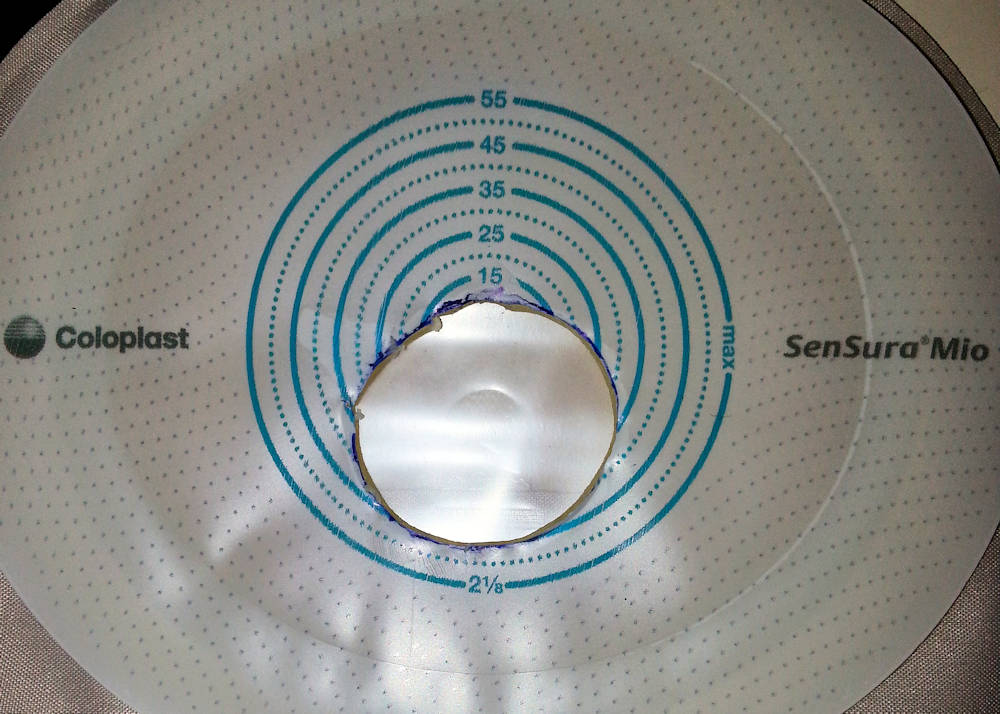
- Trace the hole on your wafer using a pen or marker.
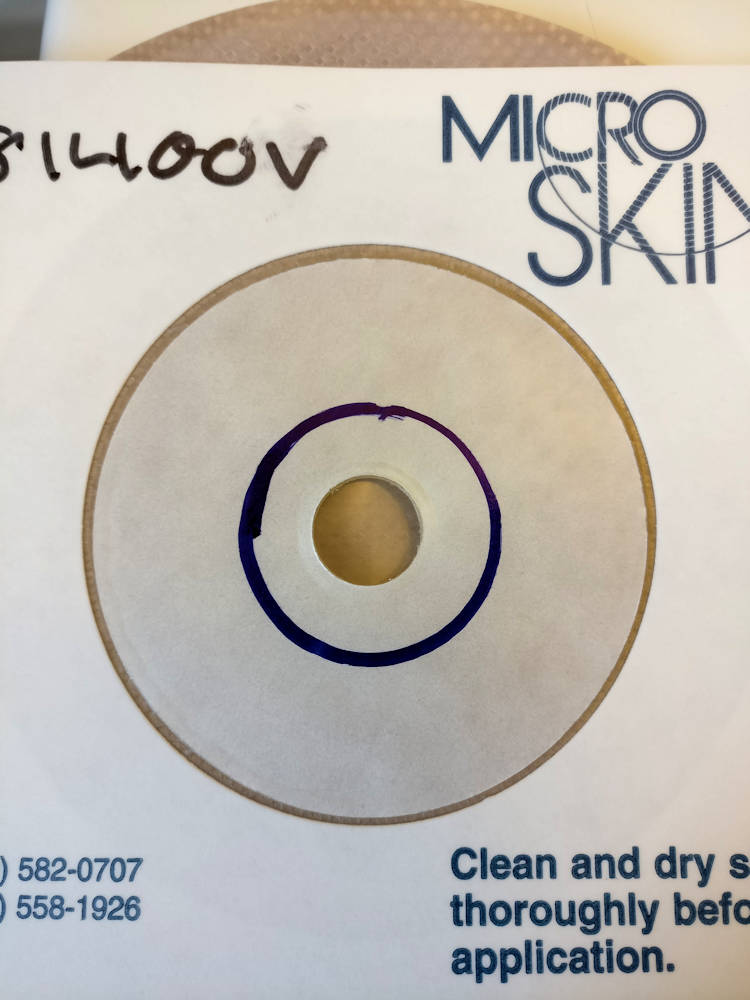
- Cut out the hole using ostomy wafer scissors. If you are using a one-piece appliance, blow into the bag first to give some space for your scissors to move.
- Test the size of the cutout by placing it over your stoma before you remove the plastic liner on the back of your wafer. Be careful as the edge of that hole may be sharp while the plastic backing is still on.

- Make any adjustments if required.
- Complete any other skin routine, including putting on a barrier ring, ostomy paste, ostomy powder, barrier wipes, etc.
- Apply your wafer.
Tip: Keep the plastic liner from your wafer and use it as a template for your next appliance change. If your stoma stays consistent, then it will be easier to use compared to the paper measuring guides.

You can use your old release backing as a new template, but test it around your stoma to make sure it’s still the ideal size.
Final Words
I hope that this guide has given you some insight on how to measure and cut the hole for your stoma.
Feel free to make small adjustments to these steps in order to accommodate your particular needs.
Question: Do you have any tips to share about measuring your stoma?


Is there a easier way to measure a oval shaped stoma
There is a couple of suggestions below I’m going to try .thank you everyone
If your stoma isn’t prone to changing size/shape very often, do your best to measure it once and then trace it on some kind of plastic or reusable material to use as a template in the future. Oftentimes, the release liners on the back of wafers can be used for this.
As for measuring, the most common way is to measure it on sections and trace it on your wafer to cut out. Some stoma measuring guides include half-circles for this purpose.
I suggested a while back to someone having trouble measuring a difficult stoma shape that they take a piece of paper, or even wax paper, or parchment paper. Trace on a circle from your wafer for size, with a ruler, run lines thru it to make uncut wedges. Then with a sharp scissors or knife cut thru the straight lines. Then you have what looks like a pie cut in wedges. Place the paper over your stoma and then fold back the wedges to the how ever close you want it to the edges of your skin and stoma. Do not make it too small, you can cause swelling and even bleeding. Check the fit with a mirror and then carefully trace it onto another piece of paper, cut it try it onto your tummy, and then trace onto your wafer., if the fit is good, you can use the plastic as Eric said for a guide to measure again. I hope this works for you.On healing the skin, it is always wise to check with your doctor to make sure whatever is going on does not need an antibiotic or a fungal cream. A fungus can be hard to clear up and needs a prescription. But if you caught a rash quickly from a leak, it will tingle mostly or burn. For myself, I have used the stoma powder, but I have also used some Penetin Baby diaper cream. However, I used q-tips and ran it between my finger to tighten the cotton, and then used a tiny bit to place on the areas hurting and then the stoma powder on top of that, and then the wafer. The cream can be hard to remove so use sparingly, it stopped further moisture from burning my skin and the stoma powder also absorbed further moisture. I had a rash so bad one day week that I replaced my one piece bag up to three times a day. The rash was oozy of clear moisture and hurt badly. I could hardly move. So, I changed the pouch often for about two days and then was able to lessen it daily as it healed. I have sensitive skin and eczema, but doing it this way helped a lot. I would also place a wet, but frozen cloth over the pouch after changing to cool the skin, protect the stoma with another cloth. I had been gardening and bent once too often and did not feel the rash taking place so this is what I got. It took a good week for the area to heal again, and not had a rash since thank Heaven. This is not what Eric or his site recommends. The experience was hit and miss.
What happens when you cut the hole to big..
If it’s only cut very slightly too large, then it usually isn’t a big problem because most wafers will puff up a bit and will fill up the gap. However, if the hole is too big, I would cut your losses and cut a new one. Using one with a hole too big may cause leaks, skin irritation, or both. I had been able to successfully use a few wafers that I had cut too large by combining them with a barrier ring – however, if you are paying for barrier rings, then this might be more costly than just using another wafer.
Hi Folks, Was having a think about this problem, and what could be SAFELY put round the stoma to then trace an image. One item I have thought of is a “pipe cleaner" these are bendable covered in cotton and would hold shape. Am thinking that fed round the stoma and used to make the shape. this could then to traced on the wafer. These are sold now a days for craft work in packs. Have to say ALWAYS be careful what goes near the stoma.
Hey John,
Ideally, once someone has a good trace of their stoma, they can reuse the plastic liner from the back of their appliance – assuming their stoma doesn’t change size/shape very often. This would be the most ideal: get it right once, and repeat the hole after that.
The pipe cleaner sounds like an interesting solution, although I don’t know how practical it would be in actual use. I know there are researchers working on a way to 3d scan stomas and print a wafer that fits exactly how it’s supposed to. Those are a long way off from hitting the market, but some people may be able to get into trials while they test the process.
Any tips on measuring a stoma that is not round? Mine is oval, about 40mm wide and 25mm in height?
Hi Tod.
Instructions on how to measure for stomas that are not round tend to be up in the air. Most of the time, you will need instructions from a stoma nurse who’s there in the room and can do it for you the first time. I have heard of some people measuring half at a time (using the same paper measuring guides I show in this video, but folding the hole in half so it’s a half-moon.
Another option would be to look at moldable wafers, which can be shaped to fit any shape stoma with relative ease.