

Barrier rings can help to prevent ostomy leaks, but most barrier rings get gooey and melt. Brava Protective Rings are Coloplast’s solution to this problem. But do they work?
Disclosure: All products used in this review were purchased by me through a local ostomy supplier.
Table of Contents
Video Review

By playing the above video you agree to YouTube's Terms and Conditions and Privacy Policy
About Brava Protective Rings
The products listed below were used for this review. Other sizes are available.
Product name: Brava Protective Ring
Manufacturer: Coloplast
Product #: 12037
Dimensions: 27mm stoma size, 2.5mm thick.
Quantity per package: 10, single-use
Product name: Brava Protective Ring
Manufacturer: Coloplast
Product #: 12047
Dimensions: 27mm stoma, 4.2mm thick.
Quantity per package: 10, single-use

The Protective Rings come in an attractive box. 
The box slides open (which is awkward). 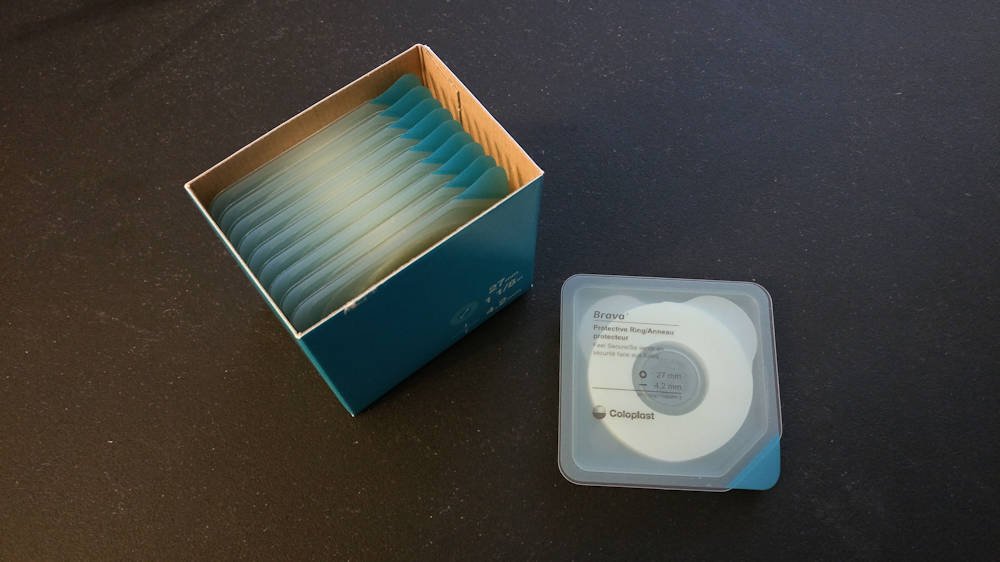
But the rings are kept neatly inside.
Part of the Brava line by Coloplast, these Protective Rings offer another option to prevent ostomy leaks and to get a better fitting appliance.
Info In the UK, this product is called “Brava Protective Seals”, not Rings.
Interestingly enough, Coloplast already offers a moldable ring product, but it seems that the Protective Ring will be replacing them eventually.
The advantage of using the Brava Protective Ring over the Brava Moldable Ring is pretty clear:
- They are more durable and less likely to “melt”.
- They are easier to handle and leave less residue.
- They are available in more sizes to fit the stoma better (currently 6 different options vs. 2).
- They come off the skin more cleanly.
These come in an attractive white and blue colored box that opens up by sliding the center part. I would have liked a traditional box that just opens on the top, but that’s just my preference.
Each Protective Ring comes in an individually sealed plastic packet, making them easy to travel with. There’s a little pull tab on one corner to open the packet. Inside, you will find the Protective Ring with plastic liners on each face (to protect it from sticking in the package). These come off easily.

Something that I really appreciate is the fact that Coloplast offers several sizes and thicknesses of Protective Rings to accommodate various stoma sizes and requirements.
Currently, the following sizes are available:
- 18mm / 2.5mm thick.
- 27mm / 2.5mm thick.
- 34mm / 2.5mm thick.
- 18mm / 4.2mm thick.
- 27mm / 4.2mm thick.
- 34mm / 4.2mm thick.
My stoma usually sits around the 30-32mm size, so I went with the 27mm ring, which can be stretched out. If you have a larger stoma, like one for a colostomy, then you have the option of going with a 34mm ring.
You can also go with rings that are either 2.5mm or 4.2mm depending on your needs.
I’m happy to report that Coloplast does not use animal ingredients in this product, which makes it suitable for vegans.
Using the Brava Protective Ring
The Brava Protective Ring works like most other barrier ring products and the instructions are the same:
- Remove the ring from the package by pulling on the blue tab.
- Remove the release liner from the face of the ring.
- Stretch it to the size/shape of your stoma.
- Either apply it directly to your skin, making sure that it’s snug around your stoma. Or, you can apply it around the hole on the back of your wafer (my preferred method).
- Proceed with putting on your appliance.

There are two release liners that need to be removed. 
You can apply the Protective Ring to the back of your wafer. 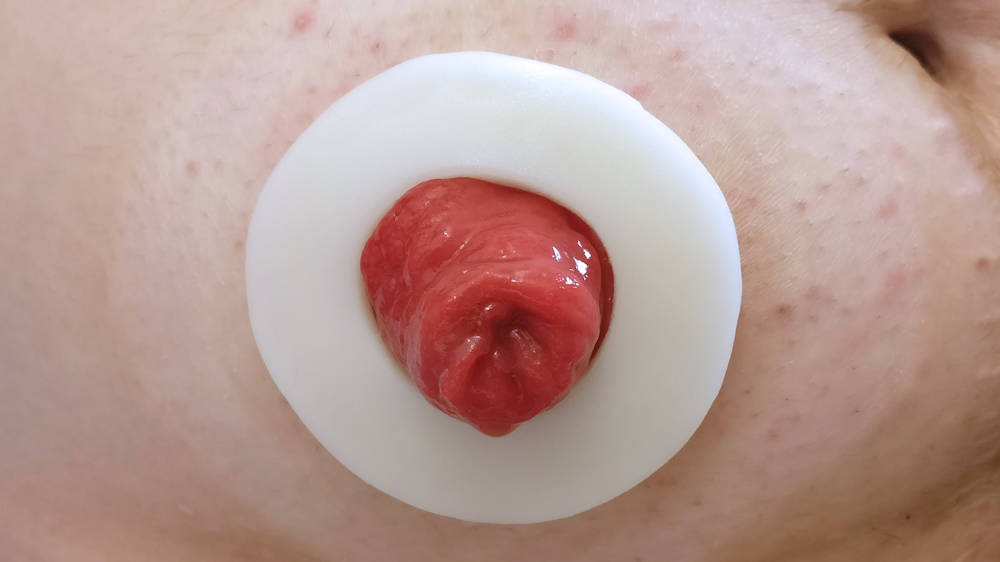
Or you can apply around your stoma.
Of note, the instructions also say that “If you use a 2-piece ostomy appliance, it is possible to apply Protective Seal directly to the coupling side of the baseplate, to achieve a snug fit around the stoma.” I did try this as I can see it coming in handy if you’ve cut your wafer too large, but I didn’t find this to be particularly effective as a gap would be left as my stoma expands and contracts with peristalsis – stick to sticking this under your wafer (no pun intended).
Speaking of filling gaps, if you were to cut your wafer a little too big, putting one of these Protective Rings under your wafer will help to protect your skin and fill in the space (see photo below for an example).

There’s really nothing special about removing the ring – I find that it comes off together with my wafer if I’m using an adhesive remover spray (which I recommend doing). You may decide to follow up by cleaning the skin to remove any residue, but it’s not really necessary unless you have to shave the area.
My experience with removing these rings is far better than with other products, which often tend to come apart or leave a sticky mess. This is a big improvement over the Brave Moldable Rings.
My Experience
Having sampled many different barrier rings from various brands, I will say that these are some of the best when as far as durability and ease of removal are concerned.
When it comes to actually handling the Protective Ring as you’re applying it, they are a bit sticky but don’t leave as much residue as other barrier ring products I’ve tried. And while I’d usually be washing my hands after handling a barrier ring, I didn’t feel the need to with these.
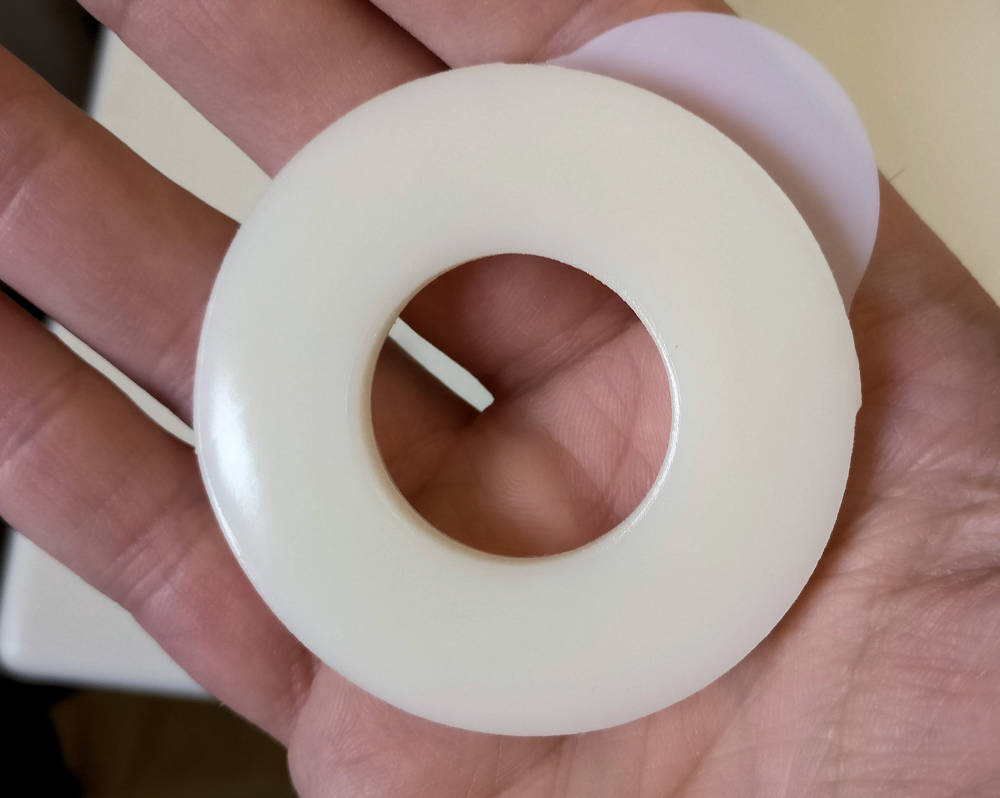
In my tests, I’ve worn these rings between two and six days of continual wear, and they don’t “melt” like I would have expected. Melting is the most common complaint from people who use barrier rings, and some products turn to mushy goo after a few days of wear.
Most surprising, however, is when it came time to removing my appliance. Usually, I would expect a sticky mess when using a barrier ring, but these come off pretty cleanly and together with my wafer (especially when you use an adhesive remover).
I won’t say that it’s perfect, though. There’s still a slight bit of residue left on the skin, but it’s mostly just tackiness – not globs of product you have to scrape off!
But do they work?
Obviously, if you’re using a barrier ring it’s likely to solve an issue with either leaks or to help fill in gaps under your appliance.
That said, I would say that my success with this product is about 70%.
I was sometimes able to get six days of wear without any leaks and minimal erosion of the product, and at other times I’d get a leak after two days. This is frustrating, to say the least, especially if the goal is to prevent leaks.
This inconsistency is something I’ve noticed with other barrier rings, including Eakin Rings, so it’s not really the fault of this particular product.
One possible reason for this is because my output is generally thicker, and barrier rings work better with thin or liquid output. That said, without a barrier ring I’m able to easily get 4+ days of wear that’s consistent and (mostly) trouble-free.
But just because these don’t work for me on a regular basis, doesn’t mean that I can’t use them off and on when my skin needs some time to heal. In fact, these are perfect to use if I have some damaged skin around my stoma, and I outline how I heal my skin in THIS article.
Conclusion
At the time of this writing (March 2017), a box of Brava Protective Rings sell for CDN$50-60 depending on the size. These are now available in Canada and the UK (Sold as “Brava Protective Seals”), but will be available in the US soon!
Samples are available from Coloplast and I would recommend you try a sample before purchasing a box just to make sure they work for your skin. I would also recommend sampling these if you already use a barrier ring product but have had trouble with excessive “melting” or removing it.
Most private insurance companies should cover these.
Pros:
- Can help to prevent leaks around the stoma.
- Available in multiple sizes and thickness’.
- Doesn’t “melt” like the Brava Moldable Rings.
- Leaves very little residue on the skin.
- Individually sealed.
- No animal ingredients.
- Can be applied to wafer or directly to your skin.
- Conforms to any required shape.
- Can be torn into a smaller size.
Cons:
- Inconsistent results (for me).
- Not available everywhere.
- Expensive.
Recommended
If you’re using the Brava Moldable Rings and find that they break down too easily or are difficult to remove cleanly, then the Brava Protective Rings will be a step up.
If you’ve used barrier rings and weren’t happy with how they worked, I would at least suggest giving these a try to see if you have a better experience.
Info: For more information or to request samples, please visit http://www.coloplast.us/ or http://www.coloplast.ca/ (If in Canada).
Question: Have you used this product?


They contain silicone, which I am HIGHLY allergic to, causing blistering oozing sores on my skin that begin with intense itching. I used only 2 sample rings sent to me by Coloplast, and within 36 hours had skin irritation even beyond my Ostomy adhesive appliance. This is also true of some sealing pastes. So, with the help of my Ostomy nurse, I am searching for an alternative to messy pastes that leave a residue and are hard to work with, and any barrier ring that contains silicone. My silicone allergy was my biggest concern before deciding to go ahead with the Colostomy surgery.
Joan, please let us know what products you find that end up working for you. Silicone allergies are quite rate, but I’m sure there are others who would benefit from knowing what’s worked for you.
Good luck!
The Brava Protective seals come off easier than the Elkin ring . Elkins melt onto skin . Spray adhesive is wonderful. Spray corner of wafer then pulse spray as you lift wafer away . Really saves your skin . Then give a spray to remove any residual adhesive. I also use square gause . I find it softer on the skin . Try the Brava spray adhesive remover its fantastic .
Hi All, I would echo what has been said, having good skin is every thing, A well built house sits on a good foundation!!
I watch that little edge around the mouth of the stoma well. I start thinking change at three days wear. And, a change when the seal seems to swell to about a 1/4 inch in anymore usually ends up in a leak. Seven days would be amazing, but then I would likely wake up with a broken damn and a ring of fire. Does wearing the ring mean a longer wear? Less leaks? Leaks was the reason I had tried them. I just find them too sticky. How do you ever get those things off in good time without sleepy legs??? I did just receive my first bottle of adhesive remover spray today and am wondering if that makes a difference in the removal of the ring? Eric, I noticed in your video that use use a packaged gauze to clean up with. Is that important, or just choice and if so, may I ask why?Linda
4 days is a good run . Skin quality is most important. Sometimes stretching days out will cause irratation . Just not worth getting oozing skin . I also use the Bravo Protective Seal . Love them . Bubbles
Hi, has anyone tried Trio siltac silicone rings ? I currently use adapt slim rings from hollister. I did use Eakins for short period of time but their quality is inconsistent and the residue they leave is awful to clean up. So I’m curious on how silicone would work.
Hi Charles. I’ve tried them, but they didn’t stick very well to my skin so they failed quickly. I’ve heard others having the same issue. But for those who have had good luck with them, they work quite well. It’s very clean to remove and doesn’t break down like regular barrier rings. Have you tried these Coloplast Brava protective rings?
I have not I just received samples from Coloplast and look forward to trying them.
Good luck! I hope they work well for you, or at least better than the eakin rings.
I was very excited about trying Trio Siltac. Unfortunately, I had two catastrophic failures in the same evening. Then I tried the Brava protective seal, which I am still trying. So far I have had good results, but I haven’t gone past 4 days yet. This week I will let it go 5 days and see how it works. I have had minor erosion, but not any more than normal when I was using stomahesive strips. I have had an ileostomy for 32 years and have been experimenting with some of the newer products and so far I am happy with the results.
Hi Valerie,
That’s disappointing to hear that the Trio Siltac did not work for you.
I’m glad that you’re getting better wear time with the Brava Protective Rings, however, it’s not imperative that you get super-long wear time, either.
If your skin looks good and you aren’t having leaks, accept four days! While we would all love to have seven-day wear, it’s not always realistic.
Best of luck!