

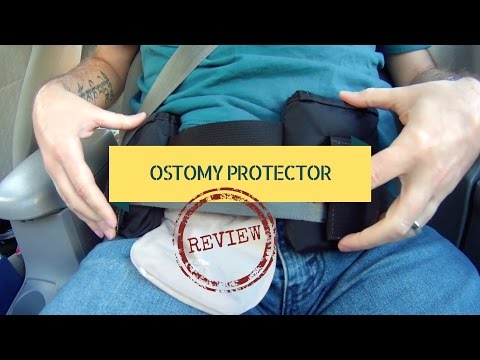
Some ostomates have concerns about wearing a seat belt, while other ostomates have had problems while trying. The Ostomy Protector aims to help with this problem by providing a unique solution to protecting your stoma.
June 2025: The company appears to be out of business. I’ve reviewed an alternative product here.
Disclosure: The nice people at Ostomy Protector were kind enough to send me this product for a review, and I’ve used it for over nine weeks to get a better understanding of how it would work in my daily life.
They played no role in the content of this review, and I received no other compensation.
Table of Contents
Video Review
By playing the above video you agree to YouTube's Terms and Conditions and Privacy Policy
About the Ostomy Protector
Product name: Ostomy Protector
Manufacturer: Aleta Wilkerson
Product #: n/a
Dimensions: Total packed size is approx. 9cm (3.54″) wide x 13cm (5.12″) tall x 6cm (2.36″) thick.
Quantity per package: 1 Seal Belt Guard
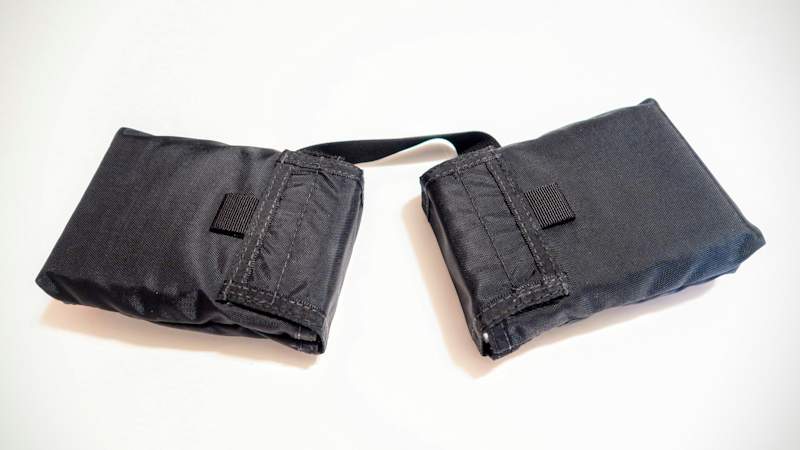
The Ostomy Protector is made up of two foam blocks that are covered with fabric; the company refers to these as “pillows”.
These blocks are approx. 9 cm (3.54″) wide by 13 cm (5.12″) tall and are firm but not hard; these blocks are also 3 cm (1.18″) thick.
Each block is joined by a strip of fabric that’s approximately 14 cm (5.51″) in length; this helps to keep the blocks from separating too far from each other.
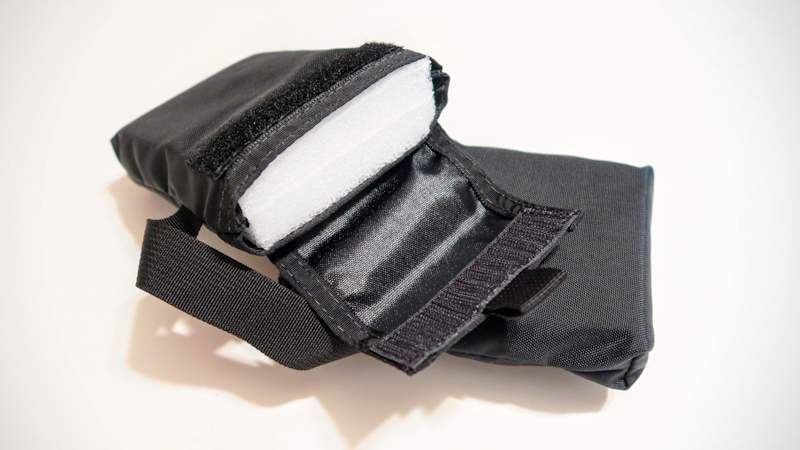
These blocks also have a Velcro loop on one side, which allows them to be attached to a seat belt easily.
Because the blocks aren’t fixed to one another, you can easily spread them to fit properly over just about any shape and size of ostomy appliance; this even works if you wear your bag horizontally.
You can remove each foam block from the sleeve they are in (so you can easily wash the product).
The main function of the Ostomy Protector is to protect your stoma from seat belts. It does this by creating a buffer between your seat belt and stoma, but it does not protect your stoma directly (like a stoma guard would).
The advantage of this is that you don’t have to wear it wherever you go, and you can keep it in your vehicle all the time.
Another advantage is that it does not interfere with the flow of your output like stoma guards can. This can be especially helpful if you’ve got thicker output and avoid stoma guards because of that.
If you travel, you can also bring it along to use on planes, taxis, or other vehicles with seat belts.
Why Even Use This?
It’s a fact that over 50% of people who’ve died in a motor vehicle accident in the United States were not wearing a seat belt (SOURCE).
I’m willing to bet that the percentage of ostomates who do not wear seat belts is even higher than the general public for several reasons:
- The belt may interfere with the appliance, making it uncomfortable to wear.
- The belt may go over the stoma, causing it to bleed or become damaged.
- Many ostomates experience leaks because their belt crushes their bag.
I would never want any of you to avoid wearing a seat belt because of these potential problems.
That’s why I use and recommend seat belt protectors like the Ostomy Protector.
Using the Ostomy Protector
To use it, you simply open the Velcro fasteners on the back of each block, place the blocks against your seat belt, then close the Velcro fasteners. You are free to adjust it after it’s on the belt.

Removing it is just as easy as you simply follow the instructions in reverse.
Alternatively, you can hang it off your pant belt to act as a stoma guard.
I gave this a try a few times but found it to be quite clumsy and very bulky compared to using a regular stoma guard, so I wouldn’t recommend that this product be used solely for that purpose.
My Experience
There’s no doubt that the Ostomy Protector does what it’s supposed to do.
I feel confident that my stoma is sufficiently protected, and it’s been able to accommodate my appliance regardless if I’m wearing it vertically or horizontally; tucked under my clothing or hanging out.
My biggest challenge is that Ostomy Protector is bulky.
I can live with the bulk for the most part, but I also like to leave it attached to my seat belt when I’m not driving, and it does get in the way when my wife is using the car.
Another concern is that when I’m wearing more than just a t-shirt, the bulk becomes even more obvious. This can be a problem because it makes using the product a bit uncomfortable.
In the winter time, especially here in Canada, coats are a must. Because of that, I would not recommend that you use this product over your coat, as it may impact the usefulness of your seat belt.
Unfortunately, wearing it under a coat (at least a short coat where the seat belt goes under it) is impractical because of the bulk it creates.
In this scenario, you either drive without your coat on or skip using this product altogether (probably ok if your coat is providing enough “padding”).
Who Needs This and Who Doesn’t
This is definitely one of those products that can either help you or do absolutely nothing for you.
If you already wear a stoma guard, then you likely won’t need this at all. But if your seat belt rests over your stoma (and it bothers you), then the Ostomy Protector will certainly make things more comfortable for you while driving.
Your stoma placement, whether it protrudes much or not, your height/weight, as well as the type of clothing you wear are all factors to be considered when determining whether this product might be right for you.
I personally find seat belt protectors, such as the Ostomy Protector, to be more useful than not.
Conclusion
At the time of this writing (Jan 2022), the Ostomy Protector sells for US$39.95 plus shipping & handling.
This is more expensive than other similar products, but it’s less expensive than most of the hard plastic stoma guards on the market.
These are also available for international delivery, which is a bonus if you can’t find a product like it in your country.
Like other accessories, this product will likely not be covered by insurance, but it’s an investment that should last you many years.
Pros:
- Helps to prevent seat belts from crushing your stoma.
- May help to prevent leaks caused by pressure from your seat belt.
- Can be used on various belts, not just ones in cars.
- Fully adjustable.
- Durable fabric.
- Avoids the need to wear a stoma guard while traveling.
- Ships internationally.
- Made in the USA.
Cons:
- Bulky, especially when compared to smaller seat belt guards.
- Moves around and often needs to be repositioned before placing it over your stoma.
- Can be quite inconvenient for those who share a vehicle with you.
- More expensive than similar products.
- Does not replace a stoma guard for protection against direct impact.
Recommended for some
The Ostomy Protector can be a valuable addition to an ostomate’s accessory kit, but it’s not for everyone. If your stoma or appliance is often in the way of wearing your seat belt, then this would be worth checking out.
I can’t recommend it as a regular stoma guard (over your pants) because it’s too bulky and doesn’t offer direct protection from impact.
For more information on the Ostomy Protector, please visit ostomyprotectorseatbelt.com
Question: Have you used this product? How did it work for you?


@oneeyegirl…Awesome Idea! Thank you! I’m certainly going to pick some tubing up & give this a try. I’m always looking for easier & better!
Hi all. My wife’s newly formed uro-stoma protrudes about 1 cm, so protecting it from the car seatbelt that would otherwise press on her stoma is imperative. I am writing this to let you know the seatbelt protector solution I made for my wife. I had some left-over 1/2-inch pipe insulation tubing (readily available at hardware stores). This stuff is tubular with a slit in one side. It is firm, but not too hard, with thick enough sidewalls to raise the seatbelt above her stoma. It can be cut to any desired length, so one side can be longer to distribute impact force over a larger part of your abdomen. I cut a smaller piece (~6 cm) of insulation tubing for the buckle side and a longer piece for the other side of the stoma. It is not necessary to fix the tubing on the seatbelt, just slip the belt through the slit, folding the belt away from the slit such that the slit is kept perpendicular to the width of the belt. The two tubing pieces are easily removed to install in another vehicle but stay sufficiently in place when in use. There’s no gluing or sewing, and it’s cheap and quick to make. My wife finds it comfortable.
@oneeyegirl I would love to see a photo of this! I’m familiar with that insulation tubing, and it sounds like an inexpensive and easy solution!
@veganostomy – My wife asked if there was a way to close the tubing while in use too (her preference.) So, I got a package of Velcro-like hook and loop at the local Walmart for $1 (craft section). I tried to glue the Velcro to the tubing with epoxy, which failed miserably. After doing some research, I determined that the tubing is made from polyethylene, which is quite resistant to gluing. Further research revealed two methods of gluing to polyethylene: one that used nasty chemicals, the other was hot melt glue. Naturally, I tried the hot melt glue which took little time to do. This method seems to be working, even after opening and closing several times. I glued a piece of the hook side on either side of the slit and a full-length piece of the loop side that goes across the opening. A six-foot piece of the tubing is available from Home Depot for $2. Photos before and after Velcro are on my Google Drive. Both experimental pieces of tubing are small.
@oneeyegirl Brilliant! Thanks for sharing that!
Yes, major issues with flow because of the seatbelt, and some vehicles are worse than others when it comes to putting pressure directly over the stoma (which is incredibly uncomfortable).
Until I used a seatbelt guard, I was quite uncomfortable.
During the winter, since my jacket isn’t super long, I do still use the seatbelt guard and wear my belt normally. Certain jackets do offer enough protection where the guard isn’t necessary, but i don’t find it necessary to remove the guard (I just slide it over if needed).
I looked at my seat belt this morning. though I have a colostomy, on the other side, the General Motors vehicles seat belt only “sits" across my waist, it applies no downward pressure or pulls down on the stoma area. possibly a little snug in summer, though I’ve never noticed? but anytime in colder weather, I see clothing providing sufficient buffering. your not strapping yourself in as a suitcase on the roof of the car.vegan did you actually experience flow problems with a seat belt or since you were concerned enough to ask the doctor, did you just start out using the guard? or maybe its the vehicle type?
Some initial thoughts. I just purchased this product and so far so good. As someone with a protuberant stoma it provides good protection. In fact, I wouldn’t be able to use something with any less padding and if I used this one directly on skin or over thin T-shirt I would likely need more padding to fully protect. We’ll see how it works once summer arrives. Regarding the issue of use in climates requiring bulky clothing. What I tend to do is unzip the bottom of my parka and position the guard over my sweater, etc. This eliminates the bulk factor but allows me to keep my much needed coat on. This may not be a readily available option for men as not all coats have the bidirectional zippers but you can also just unzip/unbutton your coat completely to reveal enough space to position the belt. I found this worked ok. The guard does require some repositioning each time as it twists when you get out and the seatbelt is retracted, but I think the minute of extra effort is worth it as I feel secure once it is in place.
@jtvtHello, Linda here….I am 5’6″ and like you mentioned lacking in fat in other places as well as my hands. My stoma falls out to a good 1 1/2 – 2 inches on average all the time. My first seat belt experience was not pleasant! My stoma is right at my usual waste band of all my clothing and seat belts, and, because it is hard to find pants with the 18 inch rise from center crotch, to just above my pouch. I have learned to carry a tape measure and will not even try pants on unless they have that 18 inch rise to below the waist band, this allows for shrinkage. I call then my chin up pants! lol. But I also found a good alterations handy for proper butt fix. I am already badly anemic and any little bump or rub, my stoma bleeds. It’s okay that you asked your own questions and nice you tried to find answers first, but we are here for you too and everyone has a different way of wording their own questions so go ahead and ask away. I know for myself I may forget to mention something in one forum but remember in another.With limited funds, I had made my own seatbelt stoma protector. I cut a section off a pool noodle and then cut that in half length wise. I then glued each half to a kitchen sponge with a bit of over hang to soften the edges of the noodle, later trimming as need be. To secure the noodle to sponge, I applied a white glue and then over night I weighted it down with heavy books till it dried. I made a tube from material I had and secured the sponges in that at the appropriate distance to keep the seat belt and the material off of and away from my stoma. Next I made another tube for a sleeve, wider, to allow for velcro and to fold over the width of a seat belt to secure it to the seat belt. Some hand sewing was involved to keep the material off my stoma and make the bridge between sponges I find this works well for me. I just leave it in the car and find no need to protect my stoma much at home. I have two little dogs now and that requires lots of bending and picking up, one is a puppy being house and now outdoor trained. I also garden and do all my own housework, most of the time. This was a cheap and easy fix for me. If you don’t sew you could always find a person who does Alterations. They are usually crafty people and like to solve problems too. Fix up your sponges ahead of time and go with a plan and perhaps some measurements. She/he should be able to work with you from there.If you don’t have material I would certainly use a pair of longer mens wool/ (or¿) work socks to accomplish the tubes. Hot glue is a handy thing and you can buy a strip of velcro at a sewing material store. Also, the only change I might make is in finding a piece of hardish plastic to make the deck for the bridge above my stoma.