
Table of Contents
Video

By playing the above video you agree to YouTube's Terms and Conditions and Privacy Policy
What Are Barrier Rings?
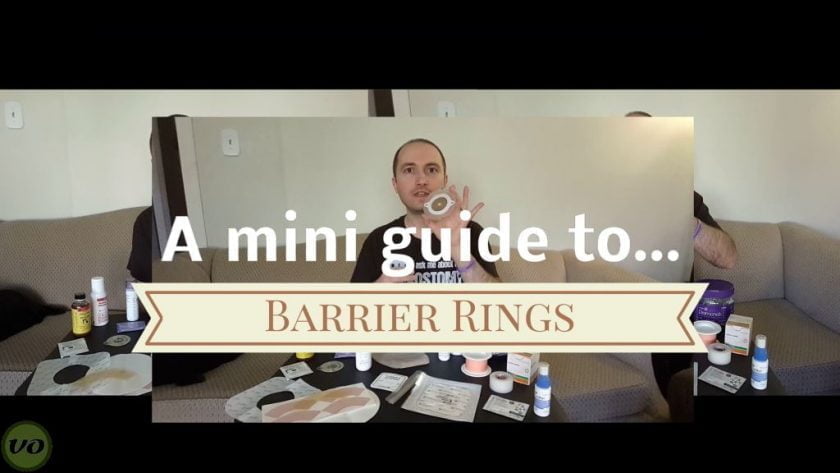
Barrier rings, which are sometimes called Eakin rings (although Eakin is just one brand of many), are often used when an ostomate experiences leaks.
Barrier rings work by swelling up around the stoma when it comes into contact with liquid or ostomy output, providing effective protection for any skin that’s exposed.
How Are Barrier Rings Sold?
Barrier Rings are boxed in quantities of 10-20 individually wrapped packages. Some brands offer two thicknesses.
These rings are usually not cheap (if you’re paying for supplies), and typical run around CDN$5.50 per ring.
Purchase on Amazon
You can purchase barrier rings on Amazon (affiliate links): USA | CANADA
How to Use Barrier Rings
These rings can either be placed around the stoma before applying the wafer, or to the wafer directly (after you remove the release liner on the wafer).
They tend to be quite sticky, and should be applied to dry, unbroken skin for best results.
Because these rings are pliable (like Play-Doh), they can be molded around your stoma for the perfect fit.


It’s best to use gentle pressure over your appliance after fitting it on top of the barrier ring, for a few minutes. This will help the ring stick to your skin better, and will allow the wafer to stick better to the ring!
In my video “How To Change an Ostomy Appliance” (found HERE), I show how I put on a barrier ring.
Tips When Using Barrier Rings
- Just because you get a ring, doesn’t mean you have to use a ring! You can easily tear these rings in half and use whatever you need.
- These rings do tend to break down and often “melt” when they are worn for prolonged periods of time, or if you sweat a lot. Some brands break down sooner than others, so it’s best to sample a few, since these tend to be expensive.
- Barrier rings can also help to fill in gaps near your stoma.
Are Barrier Rings Vegan-Friendly?
Many barrier rings contain gelatin, however, there are few (like Eakin rings – the brand) that are free of animal ingredients.
You can find an up-to-date list of which ostomy product, including rings, are free of animal ingredients HERE.


Hi… Wondering if you have any wisdom on the advantages and disadvantages of thin vs thick barrier rings. I’ve been using the thick ones. Do the thin ones break down faster? I was thinking about trying the thin ones to see if they assure a better fit.
@Lois Cooper Hi Lois. Thicker rings should delay leaks and they provide a little extra pressure which can help some people. I prefer the thin ones as thick rings tend to give me MORE leaks, but I really only use rings to heal my skin, not for leak prevention.
If you notice that your barrier rings have been breaking down or “melting" quickly, you may want to stay with the thicker ones or try another brand that is more durable.
Hi, so you don’t normally use any barrier ring or paste? You just stick the wafer / bag on? If so, are you just able to get a perfect cut on your wafers that matches the base of your stoma?
Hi Douglas,
That’s right. 99% of the time, I’m using just an appliance with no extras. This is still the most reliable for me.
For cutting the wafer, the hole is never perfect, but it’s not too wide to leave a large gap, either. Any small gap will naturally fill as the hydrocolloid in the wafer swells up.
hi Lois
I tried thicker rings and they caused more leaks for me. i find the thinner rings easier to get thin around the outside edge. i use Ovand rings from amazon. they come in 2 sizes. $16.99 for a box of 10
Is there anyone besides Coloplast that makes a barrier for a large hernia? My leaks are happening because of the creases/folds in my Hollister barrier. I have hand arthritis so it makes it EXTREMELY difficult to use the Sensura click setup.
Hi Invictus, most barrier rings can be torn, reshaped, and combined with more than one ring to get the right fit. Additionally, you may benefit from using a barrier strip, which can be contoured to fit the shape you need. Some may be easier to reshape than others, which may benefit you if arthritis is a concern. Good luck!
Hollister also carries oval, convex barrier rings which may be helpful: https://www.hollister.ca/en-ca/products/ostomy-care-products/ostomy-accessories/barrier-rings-and-strips/adapt-convex-barrier-rings
Bonjour,
j’utilise des anneaux hollister “ceraplus" j’arrive a conserver mon socle 3 jours (B.Braun ).
mais cela n’est pas indiqué si il est composé de matière animal ! merci !
Salut Betty,
J’ai confirmé avec Hollister qu’il n’y a pas d’ingrédients d’origine animale dans les CeraRings :)
I use a two piece and I have had trouble getting a perfect cut on the wafer so once I put the bag on and look through the window, after awhile the ring starts to swell up. And I was thinking last night the feces was wearing the ring down in small chunks. I don’t know if this is bad and I need to change my bag. I have done it once and the same thing happened again. I know if I take this bag off, after just putting it on last night, it will probably be very hard on my skin but if the ring being exposed through the side of the wafer is bad, I am not sure what to do. I need some advice as I am obviously having trouble. And I am also interested in hearing about putting the ring on the wafer instead of around the stoma.
Hi Sarah,
Many barrier rings do “melt" away, which means they are less effective at preventing leaks.
Have you tried different brands to see if some are better than others for you? You may also find that using a thicker barrier ring will work better in some cases compared to a thin ring (most brands offer both thicknesses).
As for putting the ring on the wafer first, I find this to be the easiest way, but it’s personal preference. Regardless of how you do it, it’s really important that your stoma (which is wet) does NOT touch the bottom of the wafer or ring or else the adhesive will not stick well.
Hi Sarah
i had a horrible time getting my wafer / rings to stick after surgery and my skin was an absolute disaster. after testing every bag, wafer, skin barrier combo i could find i finally have a routine that works for me. i know many ppl here hate hearing the old stand by that everyone is different but guess what, its true. ive had 53 surgeries, many in the abdomine area and my stomach looked like 10miles of bad road before my ileostomy. wafer always wrinkles which causes leaks.
try a different wafer. try a different skin barrier ( cavalon, skin tac, etc ) try a different bag. it took me 7 months to find the right combo of products but now my skin looks great and i rarely leak. i almost always get a comfortable leak free 5 days ( i could probly go longer but then i get hair issues )
i found the best barrier ring for me is a 2mm Ovand ( $16.99 for 10 ) silicon based ring from amazon. i use 2 coats of cavilon and then 1 coat of skin tac making sure each coat is completely dry ( not tacky ) before applying the next coat. then i apply the ring to the wafer before sticking it on. i use a b braun flexima 55mm 2 piece flang / bag. not sure if its available in north america or not. theyre NOT cheap. but. theyre worth it as my skin is now in really good shape.
hope this helps. good luck
Great tool. I will be sure to put it on my list.
Usually, the leakage occurs because of a imprecise cut of the wafer that connects to the pouch because ostomates have to do this on their own. A new technology called Lewcardia LAD is going to automate this process so everyone has a properly cut wafer. Pretty cool. Hopefully it works out.
Yes, these rings will help if you don’t make perfect cuts. I’ve seen the custom cut products being offered,however, I find that my stoma is never always the same size (fluctuates a few millimeters ),so I’d feel more comfortable measuring every time.
They do make moldable wafers, which eliminate the need to cut altogether. You might want to try those if you’ve had issues. I talk about them in an upcoming video.
Join the discussion…