

The ideal appliance will fit in a way that protects your skin while also providing a durable, and secure fit. Unfortunately, not every ostomate can achieve this balance so easily, so many will experience a breakdown of skin around the stoma.
Video

By playing the above video you agree to YouTube's Terms and Conditions and Privacy Policy
This happened to me a short while after getting my ostomy, as my new stoma was still shrinking down from its swollen state.
I was quite inexperienced, so rather than change my appliance more often, I’d try to get 5+ day wear time, which meant that as my stoma became smaller, it left room for my output to eat away at my skin.
As you can see from the photos below, I had fairly deep erosion of the skin, and it hurt a lot. At the time, I had used the “crusting technique”, which involves putting stoma powder on the exposed, raw part of my skin, dust it off and apply a barrier using either barrier wipes or cavilon spray.
You do this a few times to build up protection on the skin, and to allow the wafer to stick to something other than the powder. This technique does work for many people, but it worked very slowly for me.

More recently, as I’ve been in between wafer samples, I began to get more breakdown of the skin.
I attempted to remedy this using the crusting technique, but I wasn’t getting the results I wanted; so instead, I opted to simply use a barrier ring without any powder or barrier wipes.
The results impressed me, and my skin has probably never looked that good around the stoma.


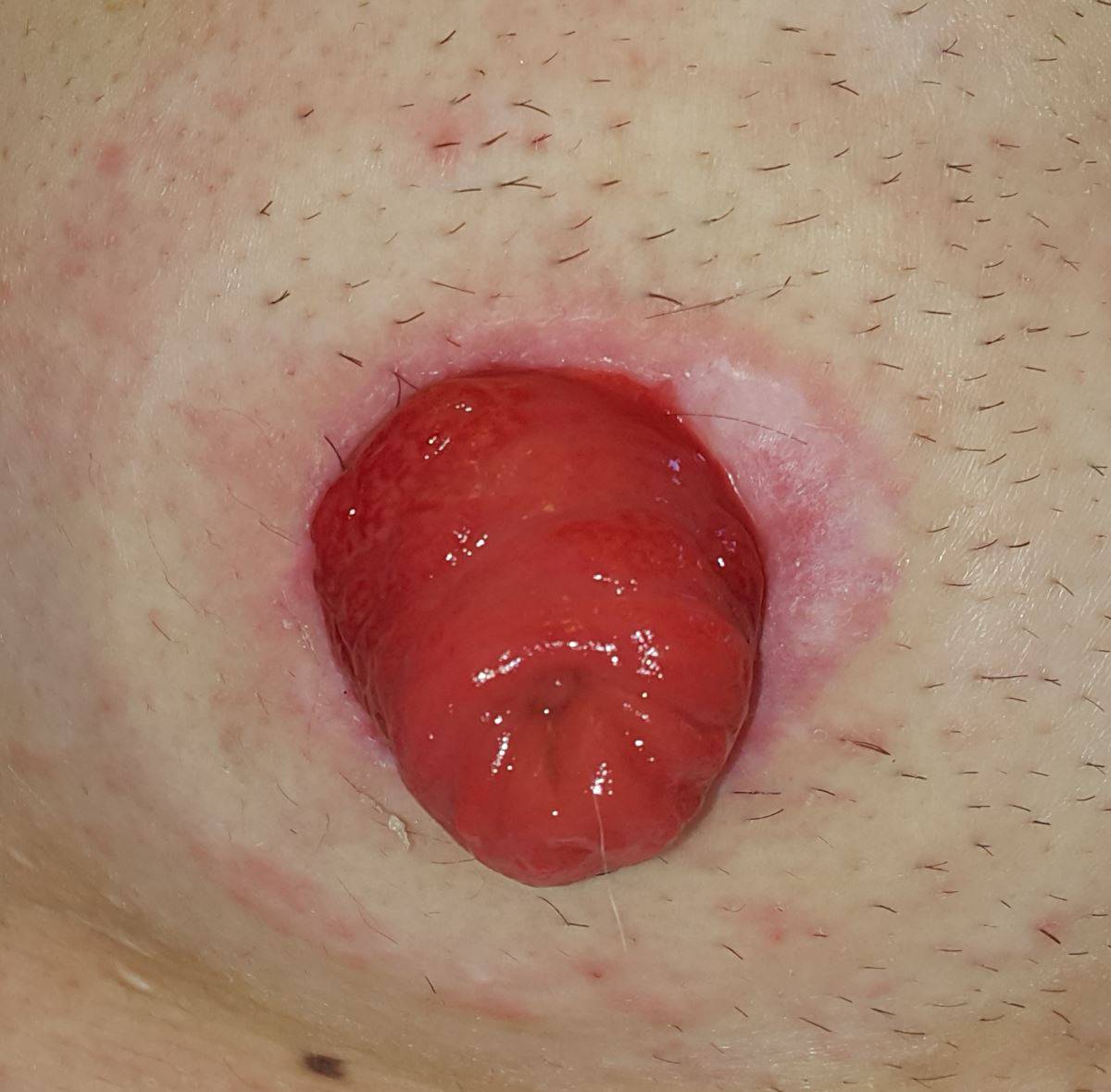
And here’s another example of how quickly this method can heal damaged skin:

Now, I continue to use a barrier ring when I notice more breakdown of the skin. I may continue to use them more regularly, but they are quite expensive and I’m not done trying new appliances that might offer a better fit.
Here’s a video showing how I change my appliance, including how I use barrier rings.

By playing the above video you agree to YouTube's Terms and Conditions and Privacy Policy
Caution: Before you change your routine, you should check with your stoma nurse first, unless you’re willing to experiment on your own.
INFO: If you’re interested in the “crusting technique” for healing peristomal skin, check out THIS article.
QUESTION: What techniques have you tried to heal up your skin?


Hi Sandra, Their are a lot of reasons for the raw skin and its a matter of trying to trouble shoot and work out why. https://www.veganostomy.ca/ostomy-leaks-tips/ " rel="ugc"> https://www.veganostomy.ca/healing-skin-around-the-stoma/https://www.veganostomy.ca/ostomy-leaks-tips/
john68 – Thank you for those tips. I will have another attempt and see how we go.
Hi Kathleen, those sore bits can be quite weepy and the orabase when applied can spread further than needed. Make sure the area is really dry and use sparingly. also I found that a little dust of stoma powder on top of the paste before the wafer helped. Any additional products always apply as little as possible.
I had my colostomy Dec 1 2017. I have tried everything that’s been suggested to me and have been to wound treatment center. It is now Oct 2018 and my area around stoma is still red and raw looking. I hope this is not what I have to look forward to from now on. Anyone have any suggestions?
Hi Sandra, I’m sorry you’ve been having ongoing issues. That’s definitely far too long to have to worry about your skin.
When you see a stoma nurse, what do they say? When you remove your wafer do you see any stool that seeped into the inner circle? How long are you wearing your appliance for? Have you tried other brands?
Troubleshooting skin problems isn’t easy, which is why a stoma nurse should always have a look – the problems can be caused by so many things, but there is a cause, and the answer is out there for you.
Hi Sandra, I want to reply because I have had ongoing skin issues for more than 2 years. I have had my colostomy since 2013. In August of 2016, my peristomal skin started itching. (I won’t go into every detail, I can hardly remember all of it anyway, since my mom and sister were both terminally ill and died during that 2 year period). Suffice it to say, I saw the WOC nurses many times, each had a different idea for me and none of the ideas helped. Early this summer, I just couldn’t take it anymore, so I went to my dermatologist. Long story short, I was eventually referred on to a specialist about 3 hours from my home. Her theory is that I used something around the time of the onset of the itching that I had an allergic response to and my skin has never had a chance to recover since it is constantly dealing with the insult of ostomy products. So, even though I have tested negative for an allergic response to the products I currently use, I have continued to have itchy, rashy, red peristomal skin. I hope this is making sense.Please ask me questions if you want more details, because there is a lot more to the story and I’m not in the clear yet. My encouragement to you is, don’t give up! You shouldn’t have to live with angry skin. Marci
Is the area the same impression as the waffer product adhesive? Is there drainage? Any eruptions on the skin?
Hi, The small points you describe sound very like granulomas. They can be quite sore depending where they are around the stoma. They can be treated by applying Orabase Paste or the silver nitrate as you describe. The silver nitrate must be used very carefully and could cause major damage to the stoma or the rest of the skin. The stoma nurse advised me to use a barrier ring on top of them as they can be weepy and cause problems under the wafer. I only use a small part as I don’t need the full ring! Again silver nitrate will burn!! and the sticks activate when wet.
I put some orabase ointment on the sore bits but then the bag wouldn’t stick to the skin. Did I do something wrong? I am trying sudocrem next.