

The ideal appliance will fit in a way that protects your skin while also providing a durable, and secure fit. Unfortunately, not every ostomate can achieve this balance so easily, so many will experience a breakdown of skin around the stoma.
Video

By playing the above video you agree to YouTube's Terms and Conditions and Privacy Policy
This happened to me a short while after getting my ostomy, as my new stoma was still shrinking down from its swollen state.
I was quite inexperienced, so rather than change my appliance more often, I’d try to get 5+ day wear time, which meant that as my stoma became smaller, it left room for my output to eat away at my skin.
As you can see from the photos below, I had fairly deep erosion of the skin, and it hurt a lot. At the time, I had used the “crusting technique”, which involves putting stoma powder on the exposed, raw part of my skin, dust it off and apply a barrier using either barrier wipes or cavilon spray.
You do this a few times to build up protection on the skin, and to allow the wafer to stick to something other than the powder. This technique does work for many people, but it worked very slowly for me.

More recently, as I’ve been in between wafer samples, I began to get more breakdown of the skin.
I attempted to remedy this using the crusting technique, but I wasn’t getting the results I wanted; so instead, I opted to simply use a barrier ring without any powder or barrier wipes.
The results impressed me, and my skin has probably never looked that good around the stoma.


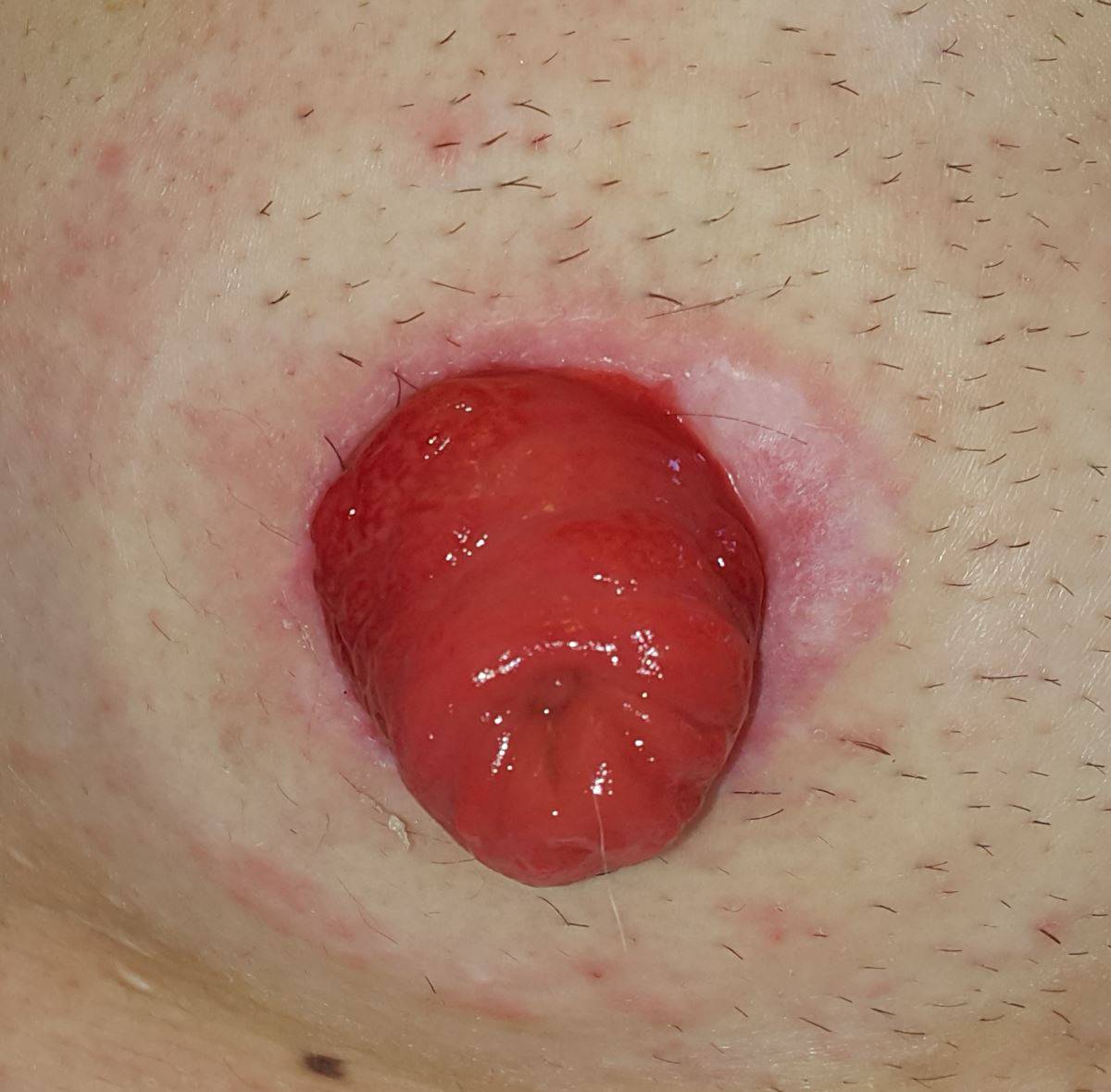
And here’s another example of how quickly this method can heal damaged skin:

Now, I continue to use a barrier ring when I notice more breakdown of the skin. I may continue to use them more regularly, but they are quite expensive and I’m not done trying new appliances that might offer a better fit.
Here’s a video showing how I change my appliance, including how I use barrier rings.
By playing the above video you agree to YouTube's Terms and Conditions and Privacy Policy
Caution: Before you change your routine, you should check with your stoma nurse first, unless you’re willing to experiment on your own.
INFO: If you’re interested in the “crusting technique” for healing peristomal skin, check out THIS article.
QUESTION: What techniques have you tried to heal up your skin?


Hi and welcome, I can’t advise on the second part of your post, but am glad to hear that barrier rings are making a difference. Lots of brands to choose from and different ways of using them.
Michelle, your client is lucky to have you. Welcome to VO. Pat yourself on the back for going the mile for your client!Kevin, same to you! Glad you are here! When I was having skin irritation in the beginning and no stoma nurse, an hour away from the GI, basically on my own, and no Eric! I have eczema, and very sensitive skin issues. The first thing I do is to take 3 connected squares of TP folded in half from side to side once. This bakes it 1 1/2 squares. Then from opposite corners, I fold that in half, it will look like two triangle flags, connected. I wrap that around my stoma to catch the fluids it makes. I use 3 ply for this and found I leave less behind on the stoma as 2 ply when I need to change it. Eric suggests using gauze squares for this job. I found going back to the basics, taking my time with cleaning the skin, water only and a soft cloth, fanning it the dry with the plastic from the back of the wafer. Adding the Barrier wipe, and or spray, fanning it dry. Spraying some on a wipe where the fold is and protect around the edge of the skin where the stoma meets. Using one end of a cottonless q-tip to gently push my stoma thru the hole it helped make the difference for me. Also if you can, fold the wafer in half where the hole is, away from your tummy, and put that on first to the lower part of the skin and stoma. Them move the stoma thru with the q-tip, and put the rest of the wafer on your tummy. Spend extra time gently pressing around the opening of the stoma hole you cut, as soon as possible to make sure you adhere it first and as well as you can, then, work on pressing on the rest of the wafer then back to around the hole a few times. I use a “warm" hot water bottle, protecting the stoma with a dry wash cloth, single layer. As soon as I can, I lay down with it over the wafer to give press gently, extra encouragement to stick where I want it to stay. Make sure you also get the slightly thicker outer edge too. If you go to long and use too warm water you risk swet forming under the wafer. I go about 5 min. fo the rest. Stay untill the area us cooler after the bottle us removed.I use barrier wipes and spray because I like a slightly thicker layer of barrier simply because my skin is so sensitive. I worry less that I have removed what I just put on using the spray. Fan dry. Now, however, I will use a square of TP folded into a triangle, then, roll it as tightly as I can from edge to edge to form a tight point. Push the stoma thru with the point, then place the rest of the wafer on your tummy. The TP makes the stoma dryer and is easier on the stoma then a tip. Try not to get TP on the wafer but if you do it is up to you if you want to risk using it or not. I find it depends on the size of TP that touched the wafer, you can judge that your self too. I rinse my bag every time I empty and then use 2-3 squares of TP, triangle it over my index finger and wrap it around it. Then slip that into the bag, finger and all. I wipe that bit of plastic that folds over on the opening. It is away from you, and I dry that first then the inside of the mouth, and as I pull it out I can easily get the corner edges clean and dried too. I hope this is helpfull to you both. Be well. Linda
Welcome Kevin, Good advice from above, as pointed out getting to the source of the problem is key, Eric has lots of help about skin condition on the site, I have come across a seal/ring from Salts which contains aloe Vera
@john68Thank You John for the advice, appreciate it!
Welcome, Kevin! You are in good hands here. Eric is a gem and very knowledgeable.I tend to use only the products that are specifically used for my ostomy. So, when I first had issues with my skin, I used a stoma barrier wipe with Holister’s stoma powder. I was also given an antifungal powder by my ostomy nurse as it appeared that what I had around my stoma was some sort of fungus. This powder cleared up my issues. I also use Sensura Mio 1-piece from Coloplast, which helps to keep my skin healthy. Good luck in finding the right solution for yourself and keep coming back here. You’ll find a great deal of info and support.God bless,Stella
Hi Eric,
I am new, my surgery was on October 17 2019. You have been more help than the ostomy nurse at the hospital!I
Has anyone tried to use 100% Aloe Vera gel on the damaged skin? It is suppose to absorb well into the skin without any residue. Maybe it would not interfere with the appliance staying on?
This process has been very hard, and you have made it a bit easier.
Thank you.
@Kevin Dieffenbach
Hi Kevin,
Welcome and thank you for asking.
I haven’t personally used aloe on the skin under my wafer, nor have it heard of any stoma nurse recommending that, so I hesitate to recommend it.
Barrier rings have helped me more than any other product in this regard, however, the cause of sore or raw skin would need to be addressed as there could be different ways to tackle the issue.
Do you know what’s causing your skin to be damaged?
@veganostomyHi Eric, thanks for your reply. I am now using barrier rings and my peristoma skin seems to be getting better. I believe I was having some leakage.i had a prostatectomy as well, and I continue to have drainage from that area. Did you or do you have this issue as well?thanks again Kevin
Aloe (above 90%) is mentioned in these articles: https://www.coloplastcare.com/siteassets/2.-routines/r1_establishing-sound-routines/r1.8-arc-guide/master_arc_guide.pdf and https://pubmed.ncbi.nlm.nih.gov/28328276/
I have tried it and it seems to work very well.
Hi after my surgery the stoma nurses here in the UK used a Manuka honey gauze pad, they cut it into strip and applied directly to the bleed. seemed to work quite well at healing it quickly. The pads were also used extensively on the patient in the next bed who had lots of weeping pressure sores on the advice of a specialist wound nurse.
Chris not be posting of late. still in recovery from the chemo/radio. I thought this bit of information might be helpful
Back soon when I’m more awake and Bagpus is less grumpy :-?
@chrisandbagpus i have been thinking of you. Chemo and radiation made my stoma grumpy, also (I, however, was a little ray of sunshine, as always – well, maybe not). Have you finished with the treatments yet?
@chrisandbagpus We all hope that you are feeling better soon!