

I’m an environmentalist at heart, and while I don’t claim to be perfect, I do try to be mindful of my impact.
Table of Contents
Introduction
Having an ostomy means you’ll be producing garbage with each appliance change.
Common items like wafers, pouches, plastic wrappings on barrier wipes and barrier rings, plastic garbage bags, or gauze pads can all add up.
Even if you’re changing your appliance every four days, that’s still over 90 appliance changes a year – that’s a lot of trash!
An ostomy product that has been a blessing to many people are pouch liners that can be flushed into your toilet, rather than discarding an entire appliance or pouch.
In this article, I’m going to examine whether we should be flushing pouch liners and what their impact might be on the environment.
A Pouch Liner Primer
If you don’t know what pouch liners are, let me give you a crash course!
There are usually several ways to get rid of waste in a full ostomy bag: you can empty it (drainable pouch), replace the pouch (closed pouch), or use pouch liners!
A drainable pouch, which is most common for people who have a urostomy or ileostomy, can be emptied many times and you can keep it on for multiple days. This is going to be the most environmentally-friendly option.
A closed pouch, which many colostomates use, is meant to be discarded and replaced whenever it gets full. This can be a few times a day to a few times per week depending on the ostomate and whether they have frequent bowel movements or irrigate their colon. This option produces more garbage compared to drainable pouches, especially if the pouch is being replaced more than a few times a day.
Pouch liners are also an option, but they tend to work better for colostomates and some ileostomates (not meant for urostomates or high-output stomas).


Think of pouch liners like a garbage bag that goes into a waste bin. Rather than throwing out the entire bin, you remove the garbage bag, throw that out, and replace it.
Pouch liners work the same way, so rather than throwing out your entire pouch, you remove and replace the pouch liner. Since pouch liners are very inexpensive compared to the pouch itself, there are economic reasons why this might be a better option for an ostomate.
The Claim
Most, if not all, traditional pouch liners are marketed as being “flushable”. This can be incredibly convenient since discarding liners into a garbage bin may not be a realistic option in every situation (although, you do have that option!).


There is at least one brand that claims that its flushable pouch liners are also biodegradable, which certainly gives it some advantages.
If the claim for biodegradation is true, then ostomates should be encouraged to use flushable, biodegradable liners as part of their regular routine because it would reduce the amount of garbage produced.
“Biodegradable” means that the liners should break down (degrade) by naturally occuring microorganisms. However, the environment and timeframe must be specified in which biodegradation is expected to occur, otherwise the claim is meaningless. (3)
Is That Actually True?
A few years ago I read an article about “flushable” products causing all kinds of chaos in municipal water treatment plants. These products were so problematic that Metro Vancouver asked citizens to stop using flushable wipes! (5)
Disposable Wipes in Sewers – Unflushables from Metro Vancouver on Vimeo.
That got me thinking, “how flushable are these pouch liners and are they truly biodegradable?”. I was on a quest to find answers!
The easiest route for me was to simply ask the manufacturer of these pouch liners for data showing how long the liners take to break down after being flushed. Easy, right? Wrong. This information isn’t readily available and their website points to nothing other than that the pouch liners are “biodegradable and flushable”. Hmm, scratch that.
My next step was to ask the company who makes the plastic used in these liners, and that led me to BASF.
BASF makes all kinds of chemical products, including biodegradable plastics!
They have many different types of biodegradable plastics which can be used in a wide number of applications, but I narrowed down my search to one product called EcoVio.
Doing a little Google Magic, I came across the patent for the Colo-Majic liners which indicate that their liners could be using EcoVio F (Film C2331), EcoVio C (Film 1200), or a combination of those films (2), but they have not publically disclosed what bioplastic is actually being used in their liners.
BASF Ecovio a bioplastic made using polylactic acid (PLA). PLA, unfortunately, requires several weeks to months to degrade, but only under very specific conditions (i.e. composting facility).
Ecovio used in compost bags can fully biodegrade in less than 30 days under specific conditions(1), which is pretty amazing and beneficial to the environment.
But we’re flushing our pouch liners using water and sending it to a place that is very different from a composting facility that’s processing compostable bags with other organic matter.
“Compostable” plastics are plastics that can biodegrade (break down) in a composting environment, which is often well-defined and would not apply to biodegradable pouch liners.
In a marine environment, however, it appears that PLA-based bioplastics stay nearly fully intact after 365 days. (6)
Note: There is no data that I’ve been able to get from either BASF, the manufacturer of these pouch liners, or my municipality on the specific time it would take pouch liners to disintegrate in a sewer system.
This information was discouraging, since someone flushing ten of these liners down their toilet for a year could be sending over 3500 mini plastic bags to their municipal water treatment plant! And that’s a best-case scenario – there’s more of a chance that they’ll clog your toilet or sewer system before they even reach the water treatment plant.
I took this information and my questions to my own municipality to ask someone who’s responsible for our sewers and water treatment and they came back with:
A majority of flushable products are not flushable and cause maintenance issues within the collection system (plugging) and at our pumping stations (fouling impellors), as well as increasing the landfill materials screened out at our plants.
We do not recommend flushing anything other than human waste and toilet paper.

Won’t They Just Biodegrade in the Landfill?
Assuming these liners are actually biodegradable, this still may not always be true.
How each landfill processes waste can have an influence on whether bioplastics will degrade in a reasonable amount of time.
In one study out of the Czech Republic that looked at five different types of “100%-degradable or certified as compostable in a municipal solid waste landfill” had very mixed results after a year. (4)
I should point out that in the above study, none of the materials were PLA-based (like the EcoVio bioplastics), but I honestly would expect them to do better than EcoVio given the ideal conditions they were given. Considering that some of these materials showed no degradation, I can’t say I’m optimistic that these pouch liners would do any better in a landfill.
An Experiment
Anything you flush should break down as it swirls down your toilet drain, which is why your municipality and just about any plumber will tell you that only human waste and a small amount of toilet paper should be flushed.
Most “flushable” wipes don’t break down, and neither do paper towels. But regular toilet paper will break down very quickly (seconds), regardless of whether it’s 1-ply or 3.
Despite what manufacturers claim, ostomy pouch liners won’t break down at all. To prove it, I’ve put together an experiment that you can try at home.
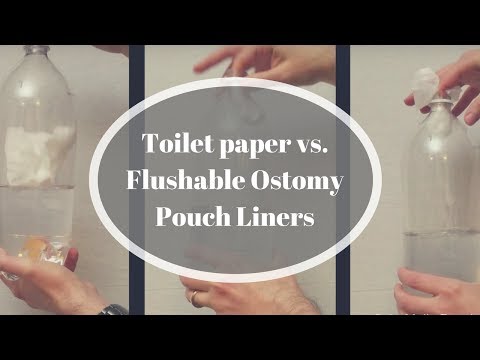
By playing the above video you agree to YouTube's Terms and Conditions and Privacy Policy
What Now?
I’m sure this information will both come as a surprise and upset people who sell and use these pouch liners, but these are the facts as I’ve been able to gather.
Ultimately, it’s up to the manufactures and vendors who sell these pouch liners to publically disclose how they came up with the “flushable” and “biodegradable” claims.
As consumers, we should be cautious about environmental claims and demand to see evidence rather than trust the marketing departments of these companies.
I personally do not use pouch liners, and if I did, this new information would make me think twice before flushing them down a toilet.
I know that there are times when pouch liners can be convenient and more affordable compared to other options, but they can also be a burden to your city’s sewer and water treatment systems (increasing maintenance costs which inevitably return as higher taxes).
I’m not telling anyone to stop using pouch liners, but I would ask that you be mindful before flushing them.
References
- Organic waste collection with compostable ecovio®bags
- Google Patents: Ostomy bag liner with vent guards, Colo-Majic Enterprises Ltd.
- Focus on “Biobased,” “Biodegradable,” & “Compostable” Plastics, Dept. of Ecology, Washington.
- Adamcová, Dana and Magdalena Daria Vaverková. “Degradation of Biodegradable/Degradable Plastics in Municipal Solid-Waste Landfill.” (2014).
- The Unflushables, Metro Vancouver
- PLA and PHA Biodegradation in the Marine Environment, California Department of Resources Recycling and Recovery
Question: Do you use “flushable” pouch liners? Has this article changed your mind about using them?

I’d be real surprised if the snake can’t rip thru bag liners. they can cut thru tree roots. 70ft and still in the house? sounds like a big house. the snake teeth should have picked up some plastic if it in fact hit a ball of bag liners.
The plumber’s in the bathroom now. The verdict’s not in, but I have a horrible feeling that it’s the liners. Flushing them for a little bit more than a year.
Oh, oh! Let us know what the verdict was 😮😮
So far, not looking good. I’m pretty sure that’s what it is.
Plumber used a 70- foot snake, couldn’t clear it. There’s talk of breaking open the floor!
I don’t know what the hell I was thinking. I’m sure I had even read your article and forgot it. When I first started using them, I was throwing them away. A bit muddled after radiation-chemo.
I haven’t mentioned this possibility because:
1) my husband will never let me forget this — he’s in his 70s, cantankerous, I’ll leave it at that
2) pathologically cheap semi-slumlord never fixes anything we ask to have repaired (e.g., part garage ceiling fell, asbestos everywhere, didn’t care about our health or her repairman’s), despite us being on time or early with rent and no trouble for years
I always fess up when I’m wrong. Not this time.
:( Well, to be fair, I wouldn’t have put the blame on you, anyway. These liners are sold as flushable, and that’s what you did.
If it ends up being the cause, I’d let the liner company know about it.
Good luck, though!!
Thanks 🤗 Still feel a little guilty, dumb.
I’ll post the finale when it’s over!
Well, the landlord arrived to have a squint at it herself. She said “it will be fixed, you know me" (why do people like her think so highly of themselves?)
Plumber returned with a new plan, a bigger snake or both. Sawed open the wall behind the toilet, went for the clog straight through the pipe and voilà, all fixed.
No cause was determined or even discussed, and I’m good with that 🙄 Not putting the liners down there anymore, though.
Now, I wonder how long it will take to seal up the wall.
Thanks for the update, Meehnan. Wow, what an ordeal.
Maybe it’s better that a cause was never determined… just in case. 😬😉
Thanks, dodged that bullet 😁👍🏻
I also have another question I had Squamish cell carcinoma on my anus and in my rectum. I cannot sit to empty my bags do most people sit or kneel on the floor to empty them .I have to kneel on the floor and that is why I prefer disposable. Is it common To kneel .
I have tried liners and I use attivia I find they are the best but after reading your article.i no longer flush them I put them in compost able dog poop bags and throw them in the outside can and if It is in the middle of the night I use the Attiva black ziplock and keep it safely tucked away until the next day .This works well for me .I have a very thick output I use closed bags and then line them with the flushable change them and it’s much easier for me .
@shazzon Thanks for sharing that! I’m glad they work for you :)
where can i purchase these Attiva bags?
Hey Shannon, it depends on where you live.
In Canada, you can purchase them in quite a few places (Canmeddirect, innergood, etc.) In the US, I believe Parthenon sells them, but I’m sure thee are quite a few more places.
Hi Sunita, they aren’t meant to break down quickly, which is part of the problem with them. They should break down in weeks/months but only if given the right conditions. This, unfortunately, gives them too much time to clog things up.
Removing the liner and disposing of it in the garbage is a reasonable compromise. If he like that method, consider getting something like a “Diaper Genie" which can be used to hold the soiled liners without worrying about smell.
Good luck!
For what it’s worth, I was always hesitant to flush the liners because of our old house plumbing. So I also empty my liner before discarding, just to make less garbage. Depending on the consistency of my poop, I can often empty the liner while it’s still in the pouch and reuse both easily, unless I happen to get debris on the edge of the liner (I use a 2 piece system).
Anyway, don’t know if this helps or not.
Hi Muffy. Out of curiosity, what advantage do you get from emptying the liner vs. using a drainable ostomy bag? I would imagine there’s more of an effort required to empty the liner and replace it, no?