

I’m an environmentalist at heart, and while I don’t claim to be perfect, I do try to be mindful of my impact.
Table of Contents
Introduction
Having an ostomy means you’ll be producing garbage with each appliance change.
Common items like wafers, pouches, plastic wrappings on barrier wipes and barrier rings, plastic garbage bags, or gauze pads can all add up.
Even if you’re changing your appliance every four days, that’s still over 90 appliance changes a year – that’s a lot of trash!
An ostomy product that has been a blessing to many people are pouch liners that can be flushed into your toilet, rather than discarding an entire appliance or pouch.
In this article, I’m going to examine whether we should be flushing pouch liners and what their impact might be on the environment.
A Pouch Liner Primer
If you don’t know what pouch liners are, let me give you a crash course!
There are usually several ways to get rid of waste in a full ostomy bag: you can empty it (drainable pouch), replace the pouch (closed pouch), or use pouch liners!
A drainable pouch, which is most common for people who have a urostomy or ileostomy, can be emptied many times and you can keep it on for multiple days. This is going to be the most environmentally-friendly option.
A closed pouch, which many colostomates use, is meant to be discarded and replaced whenever it gets full. This can be a few times a day to a few times per week depending on the ostomate and whether they have frequent bowel movements or irrigate their colon. This option produces more garbage compared to drainable pouches, especially if the pouch is being replaced more than a few times a day.
Pouch liners are also an option, but they tend to work better for colostomates and some ileostomates (not meant for urostomates or high-output stomas).


Think of pouch liners like a garbage bag that goes into a waste bin. Rather than throwing out the entire bin, you remove the garbage bag, throw that out, and replace it.
Pouch liners work the same way, so rather than throwing out your entire pouch, you remove and replace the pouch liner. Since pouch liners are very inexpensive compared to the pouch itself, there are economic reasons why this might be a better option for an ostomate.
The Claim
Most, if not all, traditional pouch liners are marketed as being “flushable”. This can be incredibly convenient since discarding liners into a garbage bin may not be a realistic option in every situation (although, you do have that option!).


There is at least one brand that claims that its flushable pouch liners are also biodegradable, which certainly gives it some advantages.
If the claim for biodegradation is true, then ostomates should be encouraged to use flushable, biodegradable liners as part of their regular routine because it would reduce the amount of garbage produced.
“Biodegradable” means that the liners should break down (degrade) by naturally occuring microorganisms. However, the environment and timeframe must be specified in which biodegradation is expected to occur, otherwise the claim is meaningless. (3)
Is That Actually True?
A few years ago I read an article about “flushable” products causing all kinds of chaos in municipal water treatment plants. These products were so problematic that Metro Vancouver asked citizens to stop using flushable wipes! (5)
Disposable Wipes in Sewers – Unflushables from Metro Vancouver on Vimeo.
That got me thinking, “how flushable are these pouch liners and are they truly biodegradable?”. I was on a quest to find answers!
The easiest route for me was to simply ask the manufacturer of these pouch liners for data showing how long the liners take to break down after being flushed. Easy, right? Wrong. This information isn’t readily available and their website points to nothing other than that the pouch liners are “biodegradable and flushable”. Hmm, scratch that.
My next step was to ask the company who makes the plastic used in these liners, and that led me to BASF.
BASF makes all kinds of chemical products, including biodegradable plastics!
They have many different types of biodegradable plastics which can be used in a wide number of applications, but I narrowed down my search to one product called EcoVio.
Doing a little Google Magic, I came across the patent for the Colo-Majic liners which indicate that their liners could be using EcoVio F (Film C2331), EcoVio C (Film 1200), or a combination of those films (2), but they have not publically disclosed what bioplastic is actually being used in their liners.
BASF Ecovio a bioplastic made using polylactic acid (PLA). PLA, unfortunately, requires several weeks to months to degrade, but only under very specific conditions (i.e. composting facility).
Ecovio used in compost bags can fully biodegrade in less than 30 days under specific conditions(1), which is pretty amazing and beneficial to the environment.
But we’re flushing our pouch liners using water and sending it to a place that is very different from a composting facility that’s processing compostable bags with other organic matter.
“Compostable” plastics are plastics that can biodegrade (break down) in a composting environment, which is often well-defined and would not apply to biodegradable pouch liners.
In a marine environment, however, it appears that PLA-based bioplastics stay nearly fully intact after 365 days. (6)
Note: There is no data that I’ve been able to get from either BASF, the manufacturer of these pouch liners, or my municipality on the specific time it would take pouch liners to disintegrate in a sewer system.
This information was discouraging, since someone flushing ten of these liners down their toilet for a year could be sending over 3500 mini plastic bags to their municipal water treatment plant! And that’s a best-case scenario – there’s more of a chance that they’ll clog your toilet or sewer system before they even reach the water treatment plant.
I took this information and my questions to my own municipality to ask someone who’s responsible for our sewers and water treatment and they came back with:
A majority of flushable products are not flushable and cause maintenance issues within the collection system (plugging) and at our pumping stations (fouling impellors), as well as increasing the landfill materials screened out at our plants.
We do not recommend flushing anything other than human waste and toilet paper.

Won’t They Just Biodegrade in the Landfill?
Assuming these liners are actually biodegradable, this still may not always be true.
How each landfill processes waste can have an influence on whether bioplastics will degrade in a reasonable amount of time.
In one study out of the Czech Republic that looked at five different types of “100%-degradable or certified as compostable in a municipal solid waste landfill” had very mixed results after a year. (4)
I should point out that in the above study, none of the materials were PLA-based (like the EcoVio bioplastics), but I honestly would expect them to do better than EcoVio given the ideal conditions they were given. Considering that some of these materials showed no degradation, I can’t say I’m optimistic that these pouch liners would do any better in a landfill.
An Experiment
Anything you flush should break down as it swirls down your toilet drain, which is why your municipality and just about any plumber will tell you that only human waste and a small amount of toilet paper should be flushed.
Most “flushable” wipes don’t break down, and neither do paper towels. But regular toilet paper will break down very quickly (seconds), regardless of whether it’s 1-ply or 3.
Despite what manufacturers claim, ostomy pouch liners won’t break down at all. To prove it, I’ve put together an experiment that you can try at home.
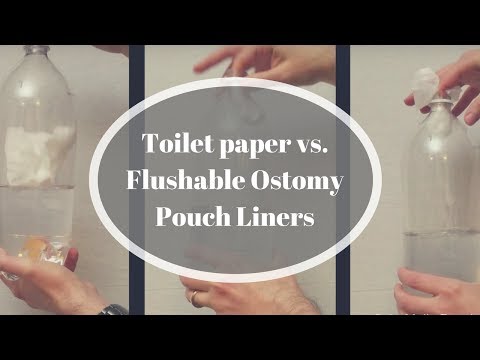
By playing the above video you agree to YouTube's Terms and Conditions and Privacy Policy
What Now?
I’m sure this information will both come as a surprise and upset people who sell and use these pouch liners, but these are the facts as I’ve been able to gather.
Ultimately, it’s up to the manufactures and vendors who sell these pouch liners to publically disclose how they came up with the “flushable” and “biodegradable” claims.
As consumers, we should be cautious about environmental claims and demand to see evidence rather than trust the marketing departments of these companies.
I personally do not use pouch liners, and if I did, this new information would make me think twice before flushing them down a toilet.
I know that there are times when pouch liners can be convenient and more affordable compared to other options, but they can also be a burden to your city’s sewer and water treatment systems (increasing maintenance costs which inevitably return as higher taxes).
I’m not telling anyone to stop using pouch liners, but I would ask that you be mindful before flushing them.
References
- Organic waste collection with compostable ecovio®bags
- Google Patents: Ostomy bag liner with vent guards, Colo-Majic Enterprises Ltd.
- Focus on “Biobased,” “Biodegradable,” & “Compostable” Plastics, Dept. of Ecology, Washington.
- Adamcová, Dana and Magdalena Daria Vaverková. “Degradation of Biodegradable/Degradable Plastics in Municipal Solid-Waste Landfill.” (2014).
- The Unflushables, Metro Vancouver
- PLA and PHA Biodegradation in the Marine Environment, California Department of Resources Recycling and Recovery
Question: Do you use “flushable” pouch liners? Has this article changed your mind about using them?


My husband has started using Colo-Magic liners and they’ve failed the flushable claim. After multiple attempts to flush liners they reluctantly went down , so he stopped flushing them. I don’t think they’re actually biodegradable either since they float just like plastic bags. Now he’s going to empty the liners as much as he can, then dispose of it in the garbage.
Very disappointing!
Hi all…Eric, this has been a very interesting topic to read as you have been discussing this topic of the biodegradable liners. Thank you Eric, not just for this topic but for all of your videos and your time. I have learned so much and am so impressed with your efforts in all you have personally done for those of us with an ostomy or two. You are so kind and thoughtful. Your videos are done to best of your knowledge and experiences with the products that you have tested. I can not imagine, not having a hernia, yet testing the product as extensively as you have in so many things, right down to the testing of the liners. I have always used a one piece and wondered about break down of them in the landfill. This has been informative and I want you to know how very much I appreciate all of your work in everything you have done here for all of us. So, a great big thank you to you, and to your family for giving of your time to us who have needed you and did not know it until we found you. You are a one of a kind and very good man to put this site together. Even after ten years of my having an ostomy, I have learned so very much through you. Bless your heat!
I think this video explains it pretty good. vegan, do you know of a material that DOES biodegrade in less than an hour? or less than 1 day? or even a couple of days?
That is a great video. Still doesn’t change the fact that EcoVio liners are not ideal for “flushable" products.
That said, it’s not really about biodegrading in a short amount of time (that would be highly problematic), it’s more about how easily it can break down when flushing. If it can’t, then it shouldn’t be flushed.
Now, if these are “compostable" in regular outdoor dirt (i.e. when you need to use bury them while camping), I could see them being highly valuable for certain people. But EcoVio, even according to the video, takes a month under ideal conditions. These conditions are hardly met under “flushable liner" use.
I saw your review on liners and thought this is great . So far I have only found colo magic and attivia both of which I did the experiment and they do not dissolve just as you said . I love the liners as I don’t have runny stools,but for some reason I cannot get them to work with the coloplast Sensura Mio click system which I really like but I want to use a liner . Also I use the Convatec accordion flange and I love it and I am able to use the liners with this . I am putting the piece together starting at the bottom and I can fit it properly when it is not on my body .Does anyone have a suggestion.
Thank you
What happens when you try? Does the ring not snap back into place or is something else happening?
The same thing happens to me with a liner and the Sensura Mio. You have to work at it a very long time to line everything up so that the closure will work. In the end I mostly just give up. But I have had instances where I can make the liner work with the pouch closure. Sometimes it works but mostly it’s hard to get things to snap into place.
Thanks for letting me know, Muffy. The flange design on the Sensura Mio must be different enough to make it hard to use liners.
The ring won’t snap into place but with the new concave flange they work well
I have been using liners for many years. There are many advantages.(filters dont plug) (I Scuba dive, play hockey , drink beer, eat chilly = fart) We had a septic system so I didn’t flush , but instead attempted to compost . My finding were that the liners needed Oxygen to break down , more than just bacteria. Adding sunlight caused a fairly fast reaction. (difficult because exposed material smell).
In Sewage/cold-water , breakdown would be extremly slow.
Previous commentors commented on the contradiction of being able to withstand holding warm moist biologic waste for hours , then quickly decompose in cold chlorine water.
I have done some experiments using PVOH to make liner bags but can’t seal the inner side (thin flim) long enough to be practical (air venting pin holes cause failure).
Still searching for a better solution.
Thanks for your input, Thor.
It would be interesting to see if any advancements come out way with liners – offering the convenience and true biodegradability.
I don’t know if this will add anything to what you’ve posted but I made an observation recently. I also use the liners but don’t flush them because of Eric’s concerns. We were in Mexico last year and when we left the country in April, I left behind 2 closed packages of liners which I placed in a plastic laundry basket with clothes and dryer sheets, to deter build-up of moisture. It’s very humid and hot where we stay in Mexico so when we returned this Nov, everything seemed fine with the liners. However, when I used them, they tended to shred a little inside my pouch. Since I brought new liners with me, I switched to them and they’re fine, don’t break up like the ones that stayed here. So whether this adds to the conversation, I’m not sure but I think the moisture and heat definitely had an effect on the liners. This won’t convince me to try and compost them, that seems a bit bizarre, but does suggest that they do break down somewhat.
MT