

I’m an environmentalist at heart, and while I don’t claim to be perfect, I do try to be mindful of my impact.
Table of Contents
Introduction
Having an ostomy means you’ll be producing garbage with each appliance change.
Common items like wafers, pouches, plastic wrappings on barrier wipes and barrier rings, plastic garbage bags, or gauze pads can all add up.
Even if you’re changing your appliance every four days, that’s still over 90 appliance changes a year – that’s a lot of trash!
An ostomy product that has been a blessing to many people are pouch liners that can be flushed into your toilet, rather than discarding an entire appliance or pouch.
In this article, I’m going to examine whether we should be flushing pouch liners and what their impact might be on the environment.
A Pouch Liner Primer
If you don’t know what pouch liners are, let me give you a crash course!
There are usually several ways to get rid of waste in a full ostomy bag: you can empty it (drainable pouch), replace the pouch (closed pouch), or use pouch liners!
A drainable pouch, which is most common for people who have a urostomy or ileostomy, can be emptied many times and you can keep it on for multiple days. This is going to be the most environmentally-friendly option.
A closed pouch, which many colostomates use, is meant to be discarded and replaced whenever it gets full. This can be a few times a day to a few times per week depending on the ostomate and whether they have frequent bowel movements or irrigate their colon. This option produces more garbage compared to drainable pouches, especially if the pouch is being replaced more than a few times a day.
Pouch liners are also an option, but they tend to work better for colostomates and some ileostomates (not meant for urostomates or high-output stomas).


Think of pouch liners like a garbage bag that goes into a waste bin. Rather than throwing out the entire bin, you remove the garbage bag, throw that out, and replace it.
Pouch liners work the same way, so rather than throwing out your entire pouch, you remove and replace the pouch liner. Since pouch liners are very inexpensive compared to the pouch itself, there are economic reasons why this might be a better option for an ostomate.
The Claim
Most, if not all, traditional pouch liners are marketed as being “flushable”. This can be incredibly convenient since discarding liners into a garbage bin may not be a realistic option in every situation (although, you do have that option!).


There is at least one brand that claims that its flushable pouch liners are also biodegradable, which certainly gives it some advantages.
If the claim for biodegradation is true, then ostomates should be encouraged to use flushable, biodegradable liners as part of their regular routine because it would reduce the amount of garbage produced.
“Biodegradable” means that the liners should break down (degrade) by naturally occuring microorganisms. However, the environment and timeframe must be specified in which biodegradation is expected to occur, otherwise the claim is meaningless. (3)
Is That Actually True?
A few years ago I read an article about “flushable” products causing all kinds of chaos in municipal water treatment plants. These products were so problematic that Metro Vancouver asked citizens to stop using flushable wipes! (5)
Disposable Wipes in Sewers – Unflushables from Metro Vancouver on Vimeo.
That got me thinking, “how flushable are these pouch liners and are they truly biodegradable?”. I was on a quest to find answers!
The easiest route for me was to simply ask the manufacturer of these pouch liners for data showing how long the liners take to break down after being flushed. Easy, right? Wrong. This information isn’t readily available and their website points to nothing other than that the pouch liners are “biodegradable and flushable”. Hmm, scratch that.
My next step was to ask the company who makes the plastic used in these liners, and that led me to BASF.
BASF makes all kinds of chemical products, including biodegradable plastics!
They have many different types of biodegradable plastics which can be used in a wide number of applications, but I narrowed down my search to one product called EcoVio.
Doing a little Google Magic, I came across the patent for the Colo-Majic liners which indicate that their liners could be using EcoVio F (Film C2331), EcoVio C (Film 1200), or a combination of those films (2), but they have not publically disclosed what bioplastic is actually being used in their liners.
BASF Ecovio a bioplastic made using polylactic acid (PLA). PLA, unfortunately, requires several weeks to months to degrade, but only under very specific conditions (i.e. composting facility).
Ecovio used in compost bags can fully biodegrade in less than 30 days under specific conditions(1), which is pretty amazing and beneficial to the environment.
But we’re flushing our pouch liners using water and sending it to a place that is very different from a composting facility that’s processing compostable bags with other organic matter.
“Compostable” plastics are plastics that can biodegrade (break down) in a composting environment, which is often well-defined and would not apply to biodegradable pouch liners.
In a marine environment, however, it appears that PLA-based bioplastics stay nearly fully intact after 365 days. (6)
Note: There is no data that I’ve been able to get from either BASF, the manufacturer of these pouch liners, or my municipality on the specific time it would take pouch liners to disintegrate in a sewer system.
This information was discouraging, since someone flushing ten of these liners down their toilet for a year could be sending over 3500 mini plastic bags to their municipal water treatment plant! And that’s a best-case scenario – there’s more of a chance that they’ll clog your toilet or sewer system before they even reach the water treatment plant.
I took this information and my questions to my own municipality to ask someone who’s responsible for our sewers and water treatment and they came back with:
A majority of flushable products are not flushable and cause maintenance issues within the collection system (plugging) and at our pumping stations (fouling impellors), as well as increasing the landfill materials screened out at our plants.
We do not recommend flushing anything other than human waste and toilet paper.

Won’t They Just Biodegrade in the Landfill?
Assuming these liners are actually biodegradable, this still may not always be true.
How each landfill processes waste can have an influence on whether bioplastics will degrade in a reasonable amount of time.
In one study out of the Czech Republic that looked at five different types of “100%-degradable or certified as compostable in a municipal solid waste landfill” had very mixed results after a year. (4)
I should point out that in the above study, none of the materials were PLA-based (like the EcoVio bioplastics), but I honestly would expect them to do better than EcoVio given the ideal conditions they were given. Considering that some of these materials showed no degradation, I can’t say I’m optimistic that these pouch liners would do any better in a landfill.
An Experiment
Anything you flush should break down as it swirls down your toilet drain, which is why your municipality and just about any plumber will tell you that only human waste and a small amount of toilet paper should be flushed.
Most “flushable” wipes don’t break down, and neither do paper towels. But regular toilet paper will break down very quickly (seconds), regardless of whether it’s 1-ply or 3.
Despite what manufacturers claim, ostomy pouch liners won’t break down at all. To prove it, I’ve put together an experiment that you can try at home.
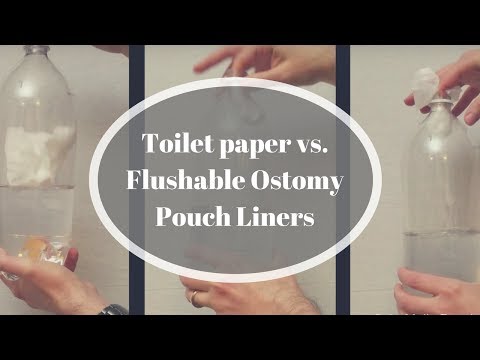
By playing the above video you agree to YouTube's Terms and Conditions and Privacy Policy
What Now?
I’m sure this information will both come as a surprise and upset people who sell and use these pouch liners, but these are the facts as I’ve been able to gather.
Ultimately, it’s up to the manufactures and vendors who sell these pouch liners to publically disclose how they came up with the “flushable” and “biodegradable” claims.
As consumers, we should be cautious about environmental claims and demand to see evidence rather than trust the marketing departments of these companies.
I personally do not use pouch liners, and if I did, this new information would make me think twice before flushing them down a toilet.
I know that there are times when pouch liners can be convenient and more affordable compared to other options, but they can also be a burden to your city’s sewer and water treatment systems (increasing maintenance costs which inevitably return as higher taxes).
I’m not telling anyone to stop using pouch liners, but I would ask that you be mindful before flushing them.
References
- Organic waste collection with compostable ecovio®bags
- Google Patents: Ostomy bag liner with vent guards, Colo-Majic Enterprises Ltd.
- Focus on “Biobased,” “Biodegradable,” & “Compostable” Plastics, Dept. of Ecology, Washington.
- Adamcová, Dana and Magdalena Daria Vaverková. “Degradation of Biodegradable/Degradable Plastics in Municipal Solid-Waste Landfill.” (2014).
- The Unflushables, Metro Vancouver
- PLA and PHA Biodegradation in the Marine Environment, California Department of Resources Recycling and Recovery
Question: Do you use “flushable” pouch liners? Has this article changed your mind about using them?


John, I think you are thinking more about, say, how acid will eat metals. from my understanding, biodegrading requires microorganisms and days to start biodegrading. its quite possible that body fluids start the bio degradation process going.vegan, you said “"""And that’s the point. We would never have the “right" environment for this type of plastic to break down under normal use."""""what then is the right environment for breakdown? I don’t quite see it in above article? thats why I suggested using a composting pile. you already know the composter is working, so all the right conditions for biodegrading are there and are happening.I think there is a mix up in terminology here. toilet paper breaking down. the paper does fall apart in water, but thats a mechanical action. biodegrading can also be called breaking down, but biodegrading is a chemical change, the toilet paper is not biodegrading in toilet, just falling apart. yes, I agree, toilet paper will fall apart in ice water same as in very warm water, but many chemical reactions occur faster in warmer than colder conditions. thats what I was referring to why nothing will happen in a cold underground sewer pipe.of course, if the liner would fall apart in toilet, it would fall apart as soon as your stoma did its thing making a liner useless. I don’t think its clear that a liner would not decompose in a treatment plant digester, at least partial biodegrade.vegan, I actually learned more with failed chemistry labs then when things went according to the book.
BASF lists specs for various bioplastics, and their conditions for proper biodegradation, but we are talking MONTHS under ideal conditions.
From my perspective, if a product isn’t able to perform as intended under normal use cases, it shouldn’t be used or should be used with caution.
I’m sure we can get these liners to degrade somewhat, but if that can’t happen within a few hours, there’s no value to ordinary users.
I propose that you try the compost pile and let us know how it goes.
so are you going to try the decompose test again? did you realize your goof? your article points to 2 reasons it wouldn’t degrade in a jug of water, plus my guess you used tap water thats been treated with chlorine, kinda makes for a sterile environment.you must have a compost pile right? of course this time of year things are grinding to a halt in backyard piles. a quick search suggests sewage treatment plants run digesters at around temperatures of 86F, or 32C. that’s a good clue that little to nothing will decompose in the underground sewer pipe, plus the very short time stuff stays in the pipe before reaching plant.Liners are probably a good solution for medical care facilities. lots of ways to reduce energy use, thus being environmental friendly. I probably throw away a shoe box of used drainable bags a year, thats really not that much to worry about. I use 8oz of water to change a bag and shave my face after. I use 24oz of water to shampoo my hair. any hot water I use, I heat on the stove. try it, its not that hard. guys can pee in yard at night, the dogs does it all the time.. every time you turn a faucet on , that water gets treated twice, treatment uses energy.
No desire to run the test again – no environment that would be realistic in a home sewage system would break down these liners. This is coming from both the manufacturer and the municipal facility that would handle it all.
And that’s the point. We would never have the “right" environment for this type of plastic to break down under normal use.
That said – toilet paper breaks down in cold tap water, so that should give you an indication of where these liners need to be to at least perform on-par.
I’m not sure what a liner is but if it holds your output I can’t see how it would be biodegradable. The acid or digestive fluids would eat it up if it were, I would think.
Composting toilets…… are amazingly simple devices. local health dept made be buy a NSF certified toilet, but my home-made home depot bucket toilet actually worked better.I strongly suggest everyone to build one themselves and try it out . basic composting idea, lots of oxygen, moist but not wet, add dry leaves,grass,maybe some peet moss, spread poop thin, don’t leave it in a baseball shape. it likes the sun(warmth).
NSF International has launched a new certification program that provides third-party verification of consumer product claims asserting they can be safely disposed of via toilet flushing.(see link below) the point i was trying to make, if there isn’t a standard for flushable or toilet disposable, then whatever goes down can be called flushable by anyone.in michigan, NSF writes the bld code for the waste water end . heres what your interested in. https://www.pmengineer.com/articles/89742-nsf-international-launches-certification-program-for-flushable-productswas the biodegrade test in the jug of water? your own article states it won’t degrade. people often put carrots and celery in water to keep longer. the hope that a liner would fall apart in the toilet is really unreasonable. thats why I remarked on Aristotle , one of his ideas was you can carefully think through an idea thoroughly without testing. your test fits this. take a liner out of the box, attach it to a warm moist area on body, have it fill with a warm liquidy substance, hold that liquid for several hours without leaking, but then fall apart seconds after it enters the toilet is just too unrealistic . think we all know, foods don’t hold up well in a warm moist environment, so a liner has to be pretty tough.I’d put a used liner in the backyard compost pile for 3 weeks and see what happens. gotta give it a fair chance.
where did this standard come from? “"""Anything you flush should break down as it swirls down your toilet drain,""""""my output is thick, it does not breakdown in a toilet, did experiment other day.how did the biodegradable test go? did you test for that?I agree for the flush-and-forget population, toilets and sewers are the most practical, but not the best for fecal waste. direct composting is the most efficient and environmentally friendly system I can think of. I’ve used a composting toilet for over 14yrs, Zero energy use.
It probably goes back a very long time! All I know is that pretty much every municipality has the same recommendations.
But it will break down at some point before reaching the water treatment plant ;)
Months later and the liner hasn’t changed one bit.
I love the idea of composting toilets, but don’t know much about them to comment.